



Why Bid Optimization Matters
Online auctions are based on a simple principle: the more you can attract bidders and the more they participate, the higher your final sale prices. Just one extra bid at the right time can increase the revenue per lot by 5–30%, depending on the category. But, many platforms, even with quality inventory and active users, are found to be losing a great portion of potential bidding activities due to bad engagement timing, weak personalization, and a lack of automated nudges. This is the point where auction bid optimization and advanced algorithm-driven strategies become indispensable.
Today modern auction systems in the digital world require more than just a straightforward listing-to-bidding flow. Platforms that implement auction bid optimization algorithms, dynamic increments, behavioural triggers, and real-time bidding system intelligence are getting an edge over those who are still waiting for user interactions to be done manually. The consequence of these algorithms is that a more competitive environment is created, more time bidders spend online, more money sellers make, and thus the overall bidder experience gets enhanced.
What Is Bid Optimization in Auctions?
Understanding How Optimization Works
Auction bid optimization refers to clever application of algorithms, behavioral tracking, and data science to multiply the number of bids for each item. The system does not wait passively for bidders to take action, but it actively guides, nudges, and influences behavior to maintain competitive bidding. These systems perfectly integrate into auction platform development, which helps platforms to increase the engagement level without the need for manual control of each auction.
Experts like Cyblance develop modern auction platforms that feature automated suggestion systems, dynamic increments, high-frequency analytics, and personalized bidder triggers. The outcome, when coupled with the best practices and layout strategies of an auction website development, is a platform that provides a safe, exciting, and profitable environment for both buyers and sellers.
Key Factors That Influence Bids per Lot
The Variables That Shape Auction Outcomes
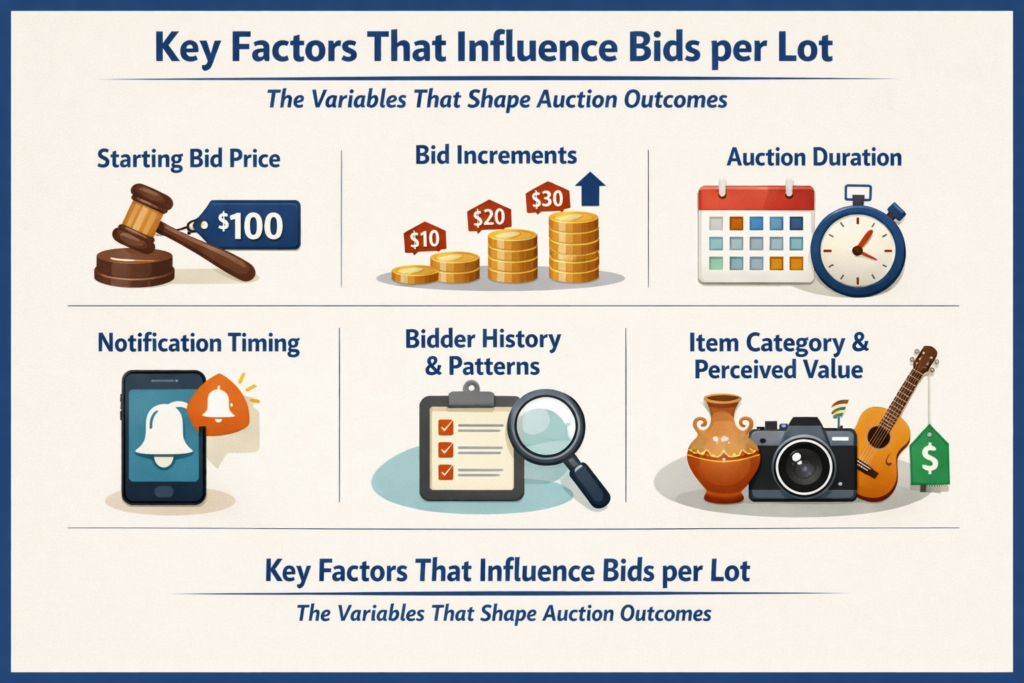
One of the factors that determines auction success is the deep understanding of bidder psychology, auction timelines, platform design, as well as engagement triggers. Modern auction analytics tools play a significant role in discovering numerous factors that affect the volume and behavior of bids.
Starting Bid Price
An appropriately optimized starting bid will allure more of the early participants and thus ensure a higher engagement. Starting at a too high price would scare away the potential bidders; on the contrary, starting at a very low price might not raise enough interest. Determining the perfect starting point for a certain category is handled by algorithms.
Bid Increments
Bid increments are what really influence the pacing of the bidding. When increments are too high, bidders tend to withdraw from the competition too quickly; on the other hand, when increments are too low, the auction goes on for too long. The smart increment algorithm is powered by bidding behavior analysis to be able to dynamically change increment values according to the real-time situation.
Auction Duration
Duration depends on the type of audience as well as the category. Algorithms take into account user activity patterns and come up with the durations that not only are optimal but also keep people engaged throughout the auction.
Notification Timing
If notifications are not well-timed, bidding opportunities will be lost. Data models are instrumental in figuring out when each bidder is the most active, thus making them more responsive.
Bidder History and Patterns
Knowing user bidding frequency, the categories of their preferences, and the times at which they are most active is the fundamental thing for personalization.
Item Category & Perceived Value
Certain categories, by nature, have a larger number of bids. Data serves to identify which items may need an extra push or dynamic increments to remain competitive.
Core Bid Optimization Algorithms
How Algorithms Drive Higher Bid Volume
Auction bid optimization algorithms automate decision-making and improve bidder interactions. These systems analyze real-time data and trigger actions that keep bidding active and competitive.
A. Time-Based Bid Nudging Algorithms
Time-based bid nudging algorithms turn on the bidders who are most likely to react at that very moment. The system, based on auctions in real time and user behavior from the past, sends closing alerts at the right time, it also applies soft-close extensions, and finally delivers personalized notifications according to the hours of each user’s peak activity. These smart nudges prevent forgotten lots by bidders, eliminate last-second sniping, and keep the competition alive, thus, in most cases, leading to a substantial increase in the overall bid volume.
B. Bidder Segmentation Algorithms
Bidder segmentation algorithms enable the platform to decide what treatment each user deserves by analyzing their bidding style, level of activity, and engagement patterns. Instead of sending the same notifications to every bidder, the system customizes alerts, reminders, and recommendations depending on whether a user is highly active, casual, inactive, or price-sensitive. The personalization level raises bidder-interaction to a new quality, retention is improved, and every user is assured to get such a type of nudge which will really motivate him/her to place another bid.
C. Dynamic Increment Adjustment
Dynamic increment adjustment algorithms keep the bidding momentum at its best by automatically changing bid increments based on the activity that is going on in real-time. If bidding is coming to a standstill, increments are lowered in order to get engagement back; on the other hand, if competitiveness becomes very intense, increments will be raised in order to get the closing prices higher at a faster pace. All these changes made according to auction performance criteria guarantee that each auction remains at the level that is best in terms of both accessibility and excitement, thus leading to smoother bidding cycles and a quite significant increase in the final sale value.
D. Machine Learning Prediction Models
Machine learning prediction models enable auction platforms to predict the behavior of bidders and figure out which lots need intervention. Supporting the foreseeing of underperforming items, identification of bidder drop-offs, and discovery of users most likely to place additional bids, these algorithms deliver the system in time for it to act before the opportunities are lost. By means of targeting based on data, the platform has the ability to start the correct promotions, alerts, or recommendations at the right time — thus, bid conversion rates and the overall auction success are improved enormously.
Real-Time Optimization Techniques
Modern platforms are able to maximize engagement with the help of real-time optimization, which allows them to perform continuous real-time monitoring of bid activity. Such live tracking is a core element for instant push notifications to work, e.g., an outbid alert or a closing reminder, that pulls the bidders to the auction in a very short time, and therefore, fast reactions are encouraged.
Moreover, personalized bid reminders along with intelligent re-targeting of inactive bidders are the driving forces to keep the energy at a high level that the platforms use. Customized alerts that are designed based on the user’s behavior, interests, and activity patterns are the perfect touch to bring the users back at the right moment, and thus participation will be increased, and the number of bids per lot will grow.
Algorithms for Increasing Engagement
Creating a Bidder Experience That Feels Alive and Interactive
Engagement algorithms are those that help bidders to find more items, keep them active for a longer period of time, and also raise their overall participation.
A. Recommendation Engine
An impressive recommendation engine offers the best suggestions of “Similar Lots You May Like” based on both user behavior and previous bids. In this manner, item discovery is enhanced, cross-lot exploration is encouraged, and the overall bidding activity and bids per lot are increased.
B. Bid Window Optimization
Bid window optimization pinpoints the most suitable moment for notifying a bidder. By sending notifications at a time when a user is most active, a platform not only achieves an increase in user engagement but also strengthens overall auction bid optimization.
C. Sniper Protection / Soft Close Algorithm
The soft close algorithm, which is a type of extension, keeps on adding time to the timer whenever it detects the presence of a last-second bid; thus, on one hand, it thwarts snipers, and on the other, it maintains competition at a fair level. As a result of that, more people participate, and auction engagement optimization reaches a higher level.
Data Models Required for Optimization
How Data Powers Algorithmic Decision-Making
Effective auction bid optimization algorithms rely on strong data models. All the insights, predictions, and automated action depends on how accurately the platform gathers, processes, and analyzes user and bidding data.
Bid History
This model records all previously bids that have been made on the platform. It is utilized to figure out the patterns of bidding, the sensitivity to prices, and the behavior of users with regarding different types of lots and price ranges.
Bidder Behavior Logs
These logs track the actions bidders take before, during, and after placing a bid. This includes viewing a lot, adding it to a watchlist, or hesitating at certain price points.
Session Activity
Session data captures engagement signals such as clicks, scroll depth, time spent on listings, and navigation paths. This allows algorithms to detect intent and interest levels in real time.
Item Category Data
Different item categories—electronics, antiques, vehicles, collectibles—behave differently in auctions. This model helps algorithms predict performance and adjust engagement triggers based on category trends.
Engagement Funnel Tracking
This model tracks the bidder journey from viewing → watching → bidding → winning. It reveals where users drop off, allowing the system to trigger timely nudges, reminders, or recommendations.
Example Optimization Workflow
How Modern Platforms Automate Bid Generation
Modern auction platforms powered by advanced technology follow an organized, algorithm-controlled workflow to attract more engagement and thus raise the number of bids per lot. In essence, this multipart procedure is a guarantee that each lot obtains the requisite level of exposure, targeted bidder outreach, and automated assistance.
Step 1: Track Activity
The system is monitoring live actions of the bidders all the time—who is participating, who is watching specific items, and which users are most likely to come back.
Step 2: Identify Low-Bid Lots
It is essentially a picking-up-of-the-wards operation where auction lots, which, by their low engagement or bid expectations, are automatically flagged for the subsequent optimization process.
Step 3: Run Prediction Models
Through the use of machine learning algorithms, the platform can identify that in cases where it can only foresee a certain underperformance, it is capable of taking the early intervention step.
Step 4: Trigger Alerts
Mails with personalized content are dispatched to those bidders who have shown interest or have a history of bidding on similar items.
Step 5: Adjust Increments or Extend Time
The aim of changing the dynamic increments or extending the soft-close time is to raise the competitiveness level, thus prompting most bidders to place further bids.
Step 6: Re-Activate Watchers
People who put the item on their watchlist receive, in most cases, targeted reminders—usually at or near the time of closing—to convert them back and thus encourage final bidding.
Impact of Optimization Algorithms
Platforms that deploy sophisticated auction bid optimization algorithms typically witness performance metric improvements that are both substantial and quantifiable across all dimensions. These algorithms, by user-timing and engagement strategic influence, alone may thus double or nearly triple the bids per lot, which in turn, generate the most significant competitive momentum that is further, more often than not, culminating in the higher final sale prices.
Furthermore, personalized experiences make bidder retention more robust thus, resulting in a larger user base that is willing to take part in future auctions, whereas more intelligent engagement strategies have a great potential to lessen the dropout rate and thus increase the participants’ length of stay. Moreover, optimal bidding similarly facilitates inventory turnover at a much faster rate than before, thus resulting in fewer lots that remain unsold. In summation, the impact of real-time monitoring, predictive alerts, and dynamic bid adjustments on overall auction engagement optimization and platform revenue is both momentous and very positive.
Conclusion
Why Every Modern Auction Platform Needs Optimization
Amid the more and more tough competition that online marketplaces present to each other, platforms using outdated systems cannot be saved. Automation, behavioral intelligence, and ML-driven engagement have become necessary rather than optional if bids are to be increased and revenue maximized. The intelligent use of auction bid optimization, auction bid optimization algorithms, real-time bidding system features, and auction analytics not only helps in the creation of an environment where bidders are well-informed, motivated, and willing to participate but is also pivotal to achieving these ends.
Cyblance, a top auction website development partner and auction platform provider, brings to the marketplace platforms equipped with AI-powered engagement, predictivealerts, dynamic increment algorithms, bid recommendation engines, and real-time tracking for an effortless online auction platform design.

FAQs
Auction bid optimization is a data-driven process that involves the use of algorithms to maximize bids per lot by perfecting the timing, engagement, and obtaining insights into bidder behavior.
By means of technology, they perform the engagement tasks that must be done at the precise moment, modify increments, and make interactions with bidders more personalized; —thus, bidding becomes more competitive as a result.
Examples include providing immediate responses to the users’ requests, updating the bid statuses as the auction progresses, and giving opportunity alerts that prevent missing the event by delivering instant notifications.
The main functions of these analytics are to reveal bidder patterns, auction item-level performance data, and user engagement trends— all of which are very important for the optimization of the next auction.
Cyblance is a well-known professional in the field of auction website development who provides turnkey, AI-driven auction solutions that are fully customizable.