



When it comes to online auction platforms, we know that these platforms put a significant effort into paid ads, marketplaces, and email campaigns in order to attract bidders. However, only a handful of these platforms consider investing in auction SEO, while it is actually one of the most potent ways to get free, highly targeted traffic. Using SEO, auction platforms can gradually establish a permanent, steady stream of suitable bidders without being forced to increase their ad budget all the time.
This blog will serve as a guide for auction house owners, vehicle auction platforms, and auto dealers talking about how auction website SEO can facilitate the ranking of auction lots on Google while attracting regular bidder traffic at the same time. The blog also outlines some of the technical, on-page, and local SEO tactics that auctions can use to go head-to-head with big marketplaces for highly relevant search traffic.
Why Auction SEO Is the “Forgotten Goldmine.”
Working in this industry for years, one thing is for sure — most of the auction businesses do not prioritize SEO. We have observed that most platforms opt for Google Ads, Facebook Ads, email marketing, or third-party marketplaces for attracting the bidders. These channels bring traffic for sure, but that traffic disappears the moment you stop paying.
We strongly believe that heavy dependence on such paid channels results in a highly vulnerable growth model. The platforms will surely find it difficult to scale profitably due to high expenses and the drop in margins. That’s why auction SEO gets overlooked—despite the fact that it quietly does the opposite.
When compared with the traditional ecommerce SEO, SEO for auctioneers addresses time-sensitive listings, auction end dates, relisted vehicles, as well as compliance-heavy vehicle data. Because of such complexity, many platforms falsely believe that SEO “won’t work” for auctions. And, here’s where most of the platforms go wrong.
When executed properly, ecommerce SEO for auctions will make vehicle lots, categories, and location pages to rank for high-intent buyer searches that paid ads frequently miss.
How People Search for Auction Lots on Google
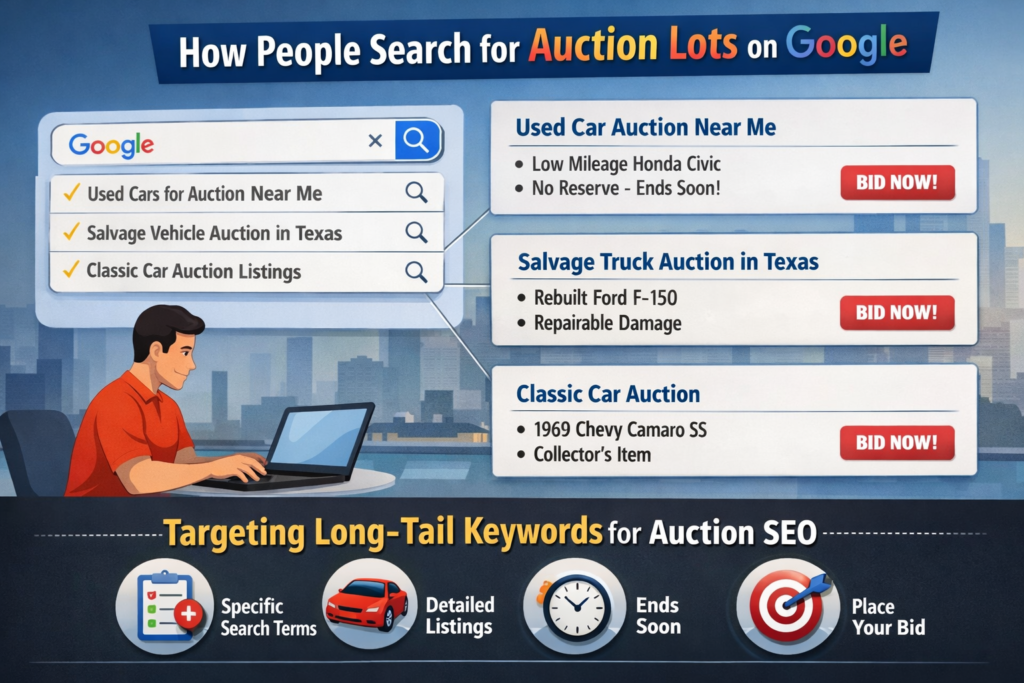
After developing numerous auction sites, one thing is clear —buyers’ search behavior rarely matches the expectations of auction platforms. Experts at Cyblance observed that on rare occasions the buyers tend to search for brand names first. They usually searched with very clear purchase intent.
The bidders searched with very specific terms such as “used cars for auction near me” or “salvage vehicle auction in Texas”. These are the bidders that aren’t browsing for information but, most likely, they’re comparing lots and deciding where to place a bid. And that’s where ranking online auction lots becomes a strong tool. Each and every auction lot by itself has all that Google needs: a very neat product, attributes defined, urgency, and user interest.
Just as the experts opine, lot-level pages practically are long-tail keywords by nature. Consider them the perfect targets for auction lot SEO and vehicle auction SEO.
How Auction SEO Turns Google Traffic Into Registrations, Bids, and Higher Hammer Prices
From our experience, we say that ranking the auction lots in Google is not enough. The greatest advantage of auction SEO is that organic search traffic is distributed effectively along the bidder funnel from discovery to registration, bidding actively, and finally the sale.
As said by our experts, a strong purchase intent like “2019 Ford F-150 auction” or “used car auctions near me” will definitely attract the users who are interested in bidding. If these users land directly on an optimized auction lot page, it becomes easier for them to review the vehicle details, inspection reports, as well as the bidding rules instantly. Thus increasing the possibility of their registration and placing bids. Remember that paid traffic usually brings casual browsers while SEO-based auction traffic converts at a much higher rate.
Why Individual Auction Lots Can Rank (If Done Right)
Each auction lot functions like its own high-intent landing page representing a single vehicle along its details like year, make, model, VIN, condition, location, and auction time period. From an SEO standpoint, such data is a treasure.
Over the years we have observed that Google prefers well-structured, detailed, and highly specific pages instead of generic marketplace listings. Marketplaces are known to reuse vehicle information through thousands of pages. On the other hand, a dedicated vehicle auction platform can develop distinct, authoritative lot pages that out rank the marketplaces.
SEO Structure for Auction Lot Pages (Core Section)
From our day-to-day experience with auction SEO we have seen that in order to succeed with auction platform SEO, lot pages must be built with search engines in mind. An SEO-friendly lot page must have a clean URL structure, mentioning the vehicle’s year, make, model, and auction identifier. Moreover, the Title tags and meta descriptions should emphasize that the vehicle is going under auction, not for sale directly.
Headings play an equally important role. One of Cyblance’s U.S.-based auto auction clients approached us with the problem that their auction lot pages were technically live but underperforming in search. Careful examination revealed that many auction lot pages had all information placed under generic headings, which was making it difficult for users and search engines to understand the page structure. Vehicle details, inspection notes, bidding instructions, and pickup information were mixed together, which resulted in increased drop-offs. Google had no clear signals about what the page was truly about beyond the basic listing.
Our experts restructured these pages with a clear H1 for the vehicle and auction context and well-defined H2 sections for condition, bidding timeline, and pickup details. Visibility and engagement improved. At the same time, they introduced structured data for vehicle specifications, auction end dates, and location information, and optimized the image handling by making sure that all the vehicle pics included descriptive alt text with the year, make, model, and condition angle. Within weeks, several lot images began appearing in Google Image results, driving additional bidder traffic directly to active auctions.
Advanced Schema Markup for Auction Visibility
Honestly, while communicating with the search engines, Schema markup plays a very important role. It is the schema markup that makes the auction lots much more noticeable in the already competitive search results. Product schema is a good choice for showing off vehicle specs, while Offer schema is used to clarify the bidding context.
Many of our clients observed an increase in sales figures after implementing such features as Product schema for vehicle specs, Offer schema for the bidding scenario, Event schema for auction timings, and Breadcrumb schema for the ease of navigation. Image schema also contributes to the highlight of Google Image search, which is, among other discovery channels, a very important one for vehicles.
Content That Helps Auction Lots Rank
While refining and optimizing multiple auction platforms over the years, we realised that one of the grave SEO mistakes auction platforms made was to rely on VIN-decoded descriptions. Google aggressively filters duplicate content, and when the same factory-generated vehicle description appears across hundreds of auction sites, marketplaces, and dealer portals, none of those pages earn real visibility. We’ve seen perfectly good auction lots fail to rank simply because their descriptions were copied word-for-word from VIN decoders.
Copied VIN data doesn’t rank. Bidder-focused descriptions do. What we’ve consistently seen is that platforms ranking at the top use custom-written vehicle descriptions crafted specifically for bidders, rather than generic content copied from VIN databases.
Important details such as pickup location, transport notes, title status, and buyer FAQs must be live directly on the lot page. From our experience, we can say that when bidders don’t have to search elsewhere for basic logistics or uncertainty drops, the dwell time increases, and conversion improves.
As in Cyblance’s auction behavior UX insights,
Trust and Compliance Signals That Strengthen Auction SEO
Frankly speaking, for high-value transactions like vehicle auctions, trust is a critical SEO signal. From our experience we can say that Google is far more cautious with pages that involve money, ownership, and legal responsibility.
While working closely with multiple auction platforms, one thing has become very clear: strong auction lot pages are transparent and feature licensing information, inspection reports, buyer protection terms, payment timelines, and pickup instructions prominently. These elements don’t just help users feel safe enough to bid—they strengthen Google’s E-E-A-T evaluation of the platform.
Technical SEO Essentials for Auction Platforms
What we’ve consistently seen is that technical issues—not content—are what hold auction SEO back. Highly skilled professionals at Cyblance suggest that expired lots should not be deleted immediately. If managed properly, they can turn into long-term SEO assets that will still be generating traffic even years after the auction closes. Hence, instead of deleting, just display a clear “auction ended” message, along with links to similar active listings.
Anyone who’s worked in auctions long enough will agree with the fact that sold and expired lots often rank for research-based searches, such as “sold price of 2018 Toyota Camry at auction” or “previous salvage car auction results.” By keeping expired lots indexed—with clear “Auction Ended” messaging, final sale prices (where permitted), and internal links to similar active auctions—platforms capture ongoing organic traffic while smoothly redirecting interest toward live inventory.
Local SEO for Auctions (Highly Underrated)
Surprisingly, we found that local SEO remains one of the most overlooked growth opportunities in today’s car auction SEO. Queries like “car auctions near me” or “vehicle auction Texas” are very powerful, signalling thel buyers who are ready to act, not just browse.

Local optimization turns auctions from “just another listing” into the obvious regional choice for ready-to-bid buyers.
Internal Linking Strategy for Auction SEO
We’ve seen great auction lots fail for one simple reason: Google couldn’t find them.
A perfectly optimized lot can be useless if it’s buried and never linked from category pages, blogs, or featured auction sections. Professionals suggest that category pages should surface active lots, blogs should point to relevant auctions, and popular listings should never be hidden from crawlers or users.
This approach aligns closely with Cyblance’s platform-first philosophy:
Scaling Auction SEO With Programmatic Pages
Imagine running an auction platform with thousands of vehicles—trying to build SEO pages one by one. It becomes similar to filling a swimming pool with a teaspoon. That’s why, in our work with large auction platforms, we’ve seen programmatic SEO become essential for long term growth.Instead of creating individual pages manually, platforms can generate structured pages based on Year-Make-Model combinations, locations, and vehicle categories.
How Auction Platforms Earn High-Authority Backlinks
Without a doubt, backlinks remain one of the strongest ranking factors in SEO—and the good news is, auction sites have plenty of opportunities to earn them naturally.
The publication of auction result reports, sold-price insights, market trend analyses, and regional auction data usually attracts citations from various automotive blogs, car dealers, journalists, and research sites. Besides that, working with logistics providers, inspection agencies, and dealer associations also helps to create authoritative links.
Common Auction SEO Mistakes
Over the years, working with numerous clients and developing a large number of auction platforms, we noted that many auction platforms were unaware of how they were killing their own auction website SEO. For example, one platform blocked search engines from indexing lot pages, reused generic VIN-decoded vehicle descriptions, and deleted listings immediately after auctions ended. While these actions might seem tidy from a management standpoint, they quietly destroyed organic visibility and severely restricted long-tail bidder traffic.
Skilled professionals at Cyblance suggest focusing more on lot pages, category pages, and vehicle listings, apart from the homepage, because they usually attract high-intent bidder searches and lead to successful conversions.
After internal linking is improved, structured data must be added, expired lots must be preserved, and local auction pages should be optimized so that organic bidder traffic is increased significantly. This experience reinforced a critical lesson: without a thoughtfully designed auction SEO strategy, platforms miss out on first-time bidders, lose long-term search visibility, and limit engagement on their most valuable listings.
Real Results: How Auction SEO Drives Long-Term Bids
Research indicates that organic search generates 53% of total website traffic, and the lead conversion rate is 14.6%, compared to 1.7% only for outbound marketing such as ads (Source: HubSpot, 2023). Organic users are generally more qualified, stay longer on auction platforms, and convert better than paid traffic, making SEO for auction websites a high-ROI strategy.
Several of our clients testify that gradually increasing organic auction traffic has reduced their dependence on paid advertisement. At the same time they observed improved bidder engagement and bidding activity. BrightEdge research shows that 68% of online interactions begin with SEO, reinforcing the long-term value of search-driven demand. From our experience we can say that our clients observed a clear shift after implementing consistent auction SEO practices.
Using SEO Data to Improve Auction Lot Rankings Over Time
From our experience, we have learnt that successful auction SEO is a continuous, data-driven process. Platforms that regularly monitor Google Search Console and performance analytics consistently outperform those that rely on assumptions or one-time optimizations.
Search Console data reveals the auction lots that have been given impressions, the queries that lead to visibility, and the points where click-through rates drop. Using these insights, auction platforms can refine lot titles, strengthen descriptions, enhance schema markup, and improve internal linking for underperforming listings.
In addition, tracking category-level and location-based performance also helps uncover demand patterns, allowing platforms to prioritize high-interest vehicle types or regions.
How Cyblance Helps Auctions Rank & Scale
Cyblance always view website SEO as an integral part of platform architecture, and not just as a marketing add-on. As an auto auction platform development partner, our focus is on SEO-first lot structures, scalable internal linking frameworks, high-performance page delivery, and long-term organic visibility built directly into the system.
As noted in Cyblance’s marketplace development insights,
“Performance, scalability, and SEO readiness must be built into the platform from day one.”
What many platforms fail to understand is that having an auction platform gives a significant SEO edge over depending on third-party marketplaces. Marketplaces hold the power to control URLs, content structure, and search visibility, whereas, a tailored auction platform offers numerous advantages of freely managing lot pages, internal linking, schema implementation, and data ownership.
For this reason, Cyblance is trusted for vehicle bidding website development and recognized not just as a technology vendor, but as a long-term growth partner for auction platforms aiming to scale organic traffic, bidder engagement, and marketplace authority.
FAQs
Proper auction SEO, along with smart management of expired and relisted vehicles, achieves rankings for time-limited listings on Google.
Reputable auction platforms provide verified inspections, transparent vehicle histories, and secure payment workflows to protect buyers.
It is possible to know a vehicle’s accurate condition from Professional inspection reports, condition grading, and detailed imagery.
After winning the auctions, the buyers get clear instructions from the seller on how to handle payments, title transfer, and either vehicle collection or delivery.
Risks are minimized through compliance-ready platforms, buyer disclosures, and structured post-sale processes.