


You might know about eBay, a big American online store where people buy and sell all kinds of stuff. It started in 1995 and in 2021, it made about 10.42 billion dollars.
Because eBay did so well, other websites like it are popping up to help people buy and sell things online. But how can you build auction website that’s better than the rest? Here are nine steps to show you how.
An auction website’s format means how the auction works on the site, like the rules and how bidding and winning happen. There are different formats for online auctions because of technology and people’s needs.This article will help you build an auction website, but you need to know what kind of auction you want first.
Step 1: Select a Domain Name
Most auction businesses aim to align their website or brand name with a domain name that closely matches. Therefore, it’s important to carefully consider your site’s name.
Opt for concise and catchy domain names that are easily memorable and can captivate users. Whenever possible, choose top-level domains like .com, .org, or .net, as they can enhance your auction website’s credibility and have a positive impact on SEO. The length of the name, its memorability, and the incorporation of relevant keywords can all influence your Google ranking.
Step 2: Preparing for Auction Website Development
Commence your preparation by crafting a product vision:
Crafting a Product Vision
A product vision serves as an articulation of the long-term value or mission of your auction website. It is typically documented in written form and shared with all team members to ensure a unified understanding of the project. In your product vision statement, you can encompass the following details and information:
Building an Auction Website
When gearing up to develop an auction platform, it is crucial to have a clear comprehension of your target audience, their needs, and how your website will fulfill those needs. To gather this essential data, thorough research will be conducted. This data will aid in validating your initial assumptions and enhancing your product vision by incorporating research insights into the mission statement.
Determining Auction Website Features

Once you have honed your product vision, you need to gain a comprehensive understanding of your product in terms of its features and functionality. Compile a list of features to include in the development of your auction website, referring to our earlier section.
Experienced developers of auction sites can offer valuable recommendations on additional features to set your solution apart from the competition. If you require assistance with auction website development, do not hesitate to reach out to us.
Selecting Integrations
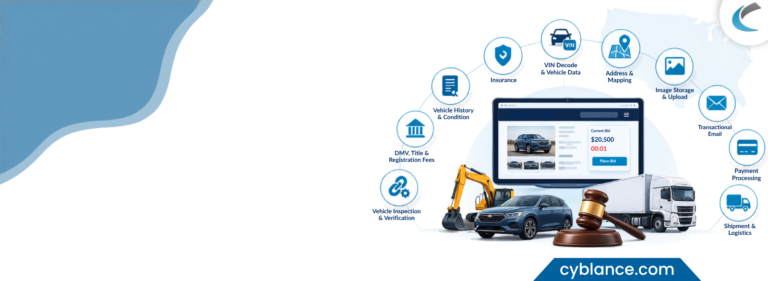
Choose the services with which your website will be integrated. For instance, you may need to integrate your auction platform with shipping services to facilitate the delivery of auction items to buyers. Opt for shipping services that best align with your location, shipping costs, and prevalent shipping methods.
Additionally, you should decide on payment integrations to incorporate into your auction website. Explore the most popular payment options in your target region. For example, in the United States, Square, Stripe, and PayPal rank among the most widely used payment methods.
Lastly, consider integrating social services. The incorporation of social services streamlines the sign-up process and enables users to link their accounts to social media, potentially enhancing brand awareness among your prospective audience.
Step 3: Immerse in UI/UX Design
The data gathered in the previous step will enable your team to create a preliminary estimate for your auction website project. This preliminary estimate is essential to ensure that your expectations align with your budget and capabilities. By verifying this alignment, you can then proceed to develop the UI/UX design based on the initial wireframes you’ve created.
UI/UX design is a comprehensive process that involves transforming your wireframes into the site’s mockup, complete with elements like a logo, color scheme, and visual components. On one hand, UI/UX design focuses on visualizing how users will perceive your auction site. On the other hand, it’s also concerned with implementing the user journey and enhancing the overall user experience. You can refer to one of our recent articles to explore the distinctions and overlaps between UI and UX in digital design.
Step 4: Select the Appropriate Technology Stack
Once you’ve collected your technical requirements and proposed design concepts, your development team can proceed to select the most suitable technology stack for your project. They will carefully choose the most effective front-end and back-end technologies to ensure that your auction site is secure, free of bugs, responsive, and high-performing.
Step 5: Assemble an Efficient Tech Team
Developing auction websites using open-source technologies is often more cost-effective than relying on paid solutions. To further optimize the cost of creating your auction website, you can explore outsourcing services and assemble an efficient software development team.
Reputable outsourcing companies with years of experience provide high-quality services at a reasonable cost. They collaborate with clients using flexible models, typically including fixed pricing, time and materials, or dedicated teams. As a global outsourcing partner, the Forbytes team can assist you with various aspects, such as:
- Strategizing your project from inception to completion.
- Selecting the most suitable technologies and agile methodologies.
- Establishing effective task management and reporting practices.
- Defining code quality standards and project key performance indicators (KPIs).
- Configuring communication tools of your choice.
Step 6: Develop a Minimum Viable Product (MVP)

MVP, which stands for Minimum Viable Product, is a fundamental concept. It represents a basic yet operational version of your product that encompasses its essential features and serves the purpose of testing the feasibility of your idea. Creating an MVP provides the opportunity to gather user feedback, refine your concept, and then progress to full-scale product development.
MVP development is a prudent decision for both startup entrepreneurs and established businesses venturing into new products. Rather than committing all their resources to full product development right away, organizations begin with an MVP. This approach allows them to confirm user interest in their product and expand the solution by introducing new compelling features
Step 7: Content Preparation for Your Auction Website
Your content specialists can collaborate with your development team in parallel as they work on building an MVP. To ensure that your auction site achieves a high ranking on Google and attracts a new audience, it’s essential to incorporate various content types. This encompasses high-resolution images, text, videos, and more. Additionally, it’s important to establish clear requirements for users who have the ability to contribute their own images and videos.
Step 8: Test and Enhance the MVP
Following the MVP launch, your primary objective is to monitor its performance and gauge the response from the target audience. Concurrently, your development team will carry out code testing and perform unit testing to verify that all features are functioning as intended. Your QA team will also conduct both manual and automated testing to identify any issues or bugs before the product goes live.
The data gathered in this phase will prove invaluable in enhancing the quality, usability, and security of your auction site. Additionally, this is an opportune time to review and organize the website documentation, which can streamline the efforts of your software engineering team.
Step 9: Construct the Auction Site and Launch the Final Solution
Now, it’s time to introduce the enhanced and improved solution to a wider audience. By utilizing the feedback and testing outcomes from the previous phase, you will gain a deeper insight into the features your product may be missing and how to make it more engaging for the audience. This data provides valuable direction on how to expand your website and where to steer your future efforts.
Concluding Remarks on Creating an Auction Website
As the statistics illustrate, developing an auction site can be a lucrative venture when executed meticulously and efficiently. In this article, we offer a comprehensive, step-by-step guide on how to establish an auction website.
The nine key steps detailed in this article encompass all facets of building an build auction website, encompassing formalities, technical and design prerequisites, project management responsibilities, product development and testing, and more.
If you have any lingering questions or require assistance with additional aspects, don’t hesitate to get in touch with us. We possess extensive experience in auction website development and can assist you in transforming your innovative ideas into reality!