

Whether you’re developing an auction platform for vehicles, industrial equipment or general merchandise, the auction engine is never the only thing you need. The real complexity arises in the third-party API layer for building an auction platform: services that validate the thing being sold, move it, insure it, and get everyone paid, all without your team ever touching a single wire transfer manually.
If you’re looking into an external services provider for a US-based auction platform, this guide covers all the categories you’ll need, what they actually do and which vendors are worth looking at. It is very heavily focused on vehicle auction use cases because that is where most of the auction-platform build requests come from in the US market, but the same stack pattern applies to equipment, real estate and general online auctions as well.
Why Auction Platforms Depend So Heavily on Integrations
For a generic e-commerce site, you need a payment gateway and shipping label API. An auction platform needs a lot more because it is usually selling something which has:
- A verifiable identity (a VIN, serial number, title)
- A physical location that must change (shipping/logistics)
- A condition that isn’t fully knowable from photos alone (inspection/history data)
- An escrow-like payment structure, where the buyer requires a guarantee before releasing the full payment
- Regulatory paperwork for the transfer (title, registration, DMV fees)
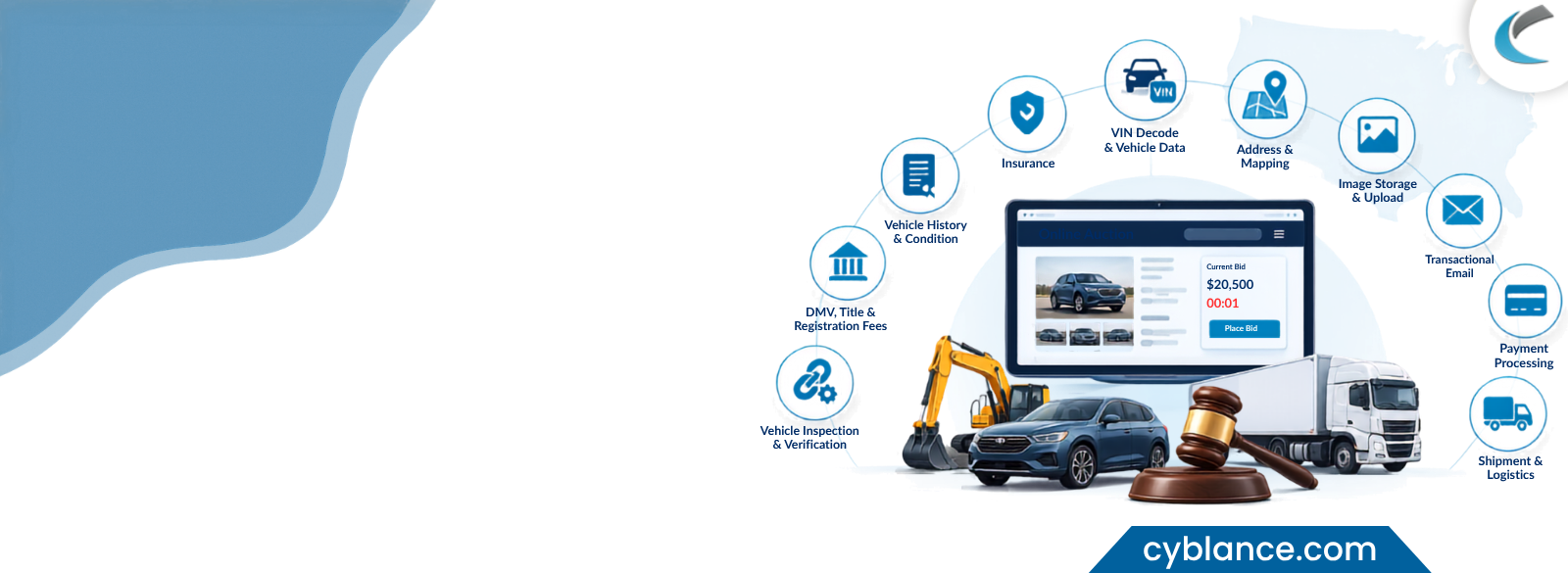
That’s why US builders typically wind up cobbling together seven or eight vendors, rather than one all-in-one SaaS, auction platform integrations. Each vendor does one narrow problem really well, and the job of the platform is really the orchestration layer that stitches them together into a single bidding-to-delivery experience. Here’s the breakdown by category, with a reference table and a practical build-order suggestion below.
1. Vehicle Data & VIN Decode
If you are selling vehicles on your auction platform, VIN decoding is the foundation for all other features. Inventory listings, search filters, valuation and even fraud checks all begin with a clean VIN decode. Get this layer wrong and every downstream feature, from search filters to shipping quotes, inherits bad data.
NHTSA vPIC (free, baseline data) The National Highway Traffic Safety Administration’s Product Information Catalog is the default starting point for a VIN decode API auction integration, and for good reason: it’s a US government open-data API, it’s completely free, requires no API key or registration, and there’s no daily call limit. It’s populated using information manufacturers submit to NHTSA under federal law, and covers passenger cars, trucks, motorcycles, buses, trailers, and low-speed vehicles sold or imported in the US.
A single DecodeVin call returns up to 140 attributes, and the batch endpoint can decode up to 50 VINs in one request, useful if you’re bulk-importing auction lots from a legacy system or a dealer feed. The one caveat: decode coverage for vehicles from 1980–1994 sits around 60–65%, and nothing before 1980 is covered at all, since VINs weren’t standardized in the US before then.
vPIC gives you make, model, year, trim, plant location, engine, and body type- solid base data, but nothing on pricing, accident history, or title status. For a large share of general auction platforms, that base layer is genuinely enough; the paid tier only becomes necessary once buyers are making higher-stakes bidding decisions.
Paid alternatives for deeper data:
- ClearVin: accident, salvage, and title-brand history, positioned for dealers and auction platforms that need a fuller history report alongside the decode.
- MarketCheck: pulls live market pricing and inventory data, useful if your platform wants to show comparable sale prices next to a lot.
- VinAudit: combines decode with title, theft, and lien records, aimed at buyers who want a due-diligence layer before bidding.
Most platforms run vPIC as the default decode and layer in one paid provider only where trim-level specs or history reporting is part of the paid buyer experience.
2. Address & Mapping
Every auction platform needs to know where a lot physically sits, for search radius filters, shipping quote estimates, and seller/buyer address validation at checkout. Google Maps Platform (Places, Geocoding, and Distance Matrix APIs) is your best bet for address autocomplete on listing creation, geocoding for “auctions near me” search, and distance calculations that feed directly into shipping cost estimates. It’s a small line item in the overall budget but touches almost every part of the buyer and seller onboarding flow, so it’s worth setting up early rather than retrofitting later.
3. Image Upload & Storage
Auction listings live or die on photo quality and photo count; most vehicle and equipment auctions need 15–30+ images per lot, often uploaded directly from a mobile device at the point of sale, sometimes with spotty connectivity from a lot or yard.
The standard here is AWS S3, almost always done via a presigned URL flow: the browser or app asks your backend for a short-lived, scoped upload URL, then uploads the image file directly to S3 without ever passing through your app server. That means low upload latency and zero server load off of your compute layer, which is critical when a seller is uploading two dozen high-res photos of a vehicle in one session, or when multiple sellers are uploading at the same time in a busy listing window.
Alternatives:
- Digital Ocean Spaces: S3-compatible API, often preferred for predictable cost on medium sized platforms.
- Cloudinary: Adds on-the-fly image transformation and optimization. Useful if you want automatic thumbnail generation and responsive image delivery without building that pipeline yourself.
- Azure Blob Storage: An obvious choice if your infrastructure is already on Azure.
4. Transactional Email
Auctions are powered by time-sensitive notifications. Outbid alerts, closing auction reminders, payment confirmations, shipment updates. Mailgun is often a good choice for this layer due to its deliverability tracking, template support, and simple REST API. This is important because outbid and closing-soon emails need to land in the inbox reliably and quickly, not sit in a queue while a lot closes without the buyer knowing they’ve been outbid.
5. Payment Processing
This is where an auction platform payment gateway decision gets genuinely complex, because auctions aren’t a simple buy-now checkout; buyers commit to a bid, a winner is determined after the fact, and funds often need to be held until delivery or title transfer is confirmed.
Stripe, layered with Stripe Connect, is the standard architecture:
- Stripe Connect onboards each seller as a connected account and handles split payments, your platform commission and the seller’s payout calculated automatically per transaction.
- For the escrow-like behavior auction platforms need, Stripe doesn’t offer a licensed escrow product, since that term has a precise legal definition and Stripe doesn’t support escrow accounts directly, but it does provide the practical equivalent. By setting the transfer schedule to manual, Stripe holds funds in the connected account’s balance until your platform explicitly triggers a payout, for up to 90 days. That’s the mechanism most marketplaces use to hold a winning bidder’s payment until the vehicle or item is confirmed delivered before releasing funds to the seller.
This “manual payout” pattern is exactly how consumer marketplaces like Vinted and OfferUp structure trust into their payment flow, and it maps directly onto auction settlement: bid wins, payment is captured, funds are held, delivery or title transfer is confirmed, and only then is the payout released to the seller. Building this flow correctly from day one avoids a much harder retrofit once real transaction volume is flowing through the platform.
6. Vehicle Shipment & Logistics
Once a vehicle auction closes, someone has to move the car from seller to buyer, often across state lines. Super Dispatch is the dominant vehicle shipment API in this space, built specifically for auto transport, and it’s explicitly positioned to serve auction houses, brokers, and dealerships that need to dispatch vehicles, combining a dedicated TMS with the Super Loadboard.
What it gives an integrated auction platform:
- Full Shipper TMS functionality via API, order creation, posting to load boards, direct offers, price negotiation, carrier network management, and real-time order updates
- Electronic bills of lading, proof-of-delivery, and digital inspection photos captured automatically at pickup and delivery
- Carrier vetting: Super Dispatch monitors FMCSA authority and insurance status on carriers on your behalf, which matters for platform liability
- A Pricing Insights API that returns machine-learning-driven shipping cost estimates based on recent moves and posted loads along similar routes, which is what lets you show buyers an estimated shipping cost at the point of bidding rather than after
For a US auction platform, quoting shipping cost before the auction closes, not after, is a real conversion factor; buyers bid differently when they can see landed cost up front instead of discovering the freight bill after they’ve already won.
7. DMV, Title & Registration Fees
Every vehicle sale in the US eventually runs into a state DMV. A DMV API integration handles title transfer status checks, registration fee estimation by state, and sales/use tax calculation, critical for showing buyers an accurate “out the door” number before they bid, since title and registration fees vary meaningfully by state and sometimes by county. This is a fragmented vendor space in the US, since fee schedules differ across all 50 states, so most platforms integrate a specialized DMV data provider rather than building fee tables in-house; the rules change too often to maintain internally, and getting a fee estimate wrong at checkout is a fast way to erode buyer trust.
8. Vehicle History & Condition
Buyers bidding sight-unseen need independent condition and history signals beyond the seller’s own listing. This is where a service like Drive Caramel fits; it authenticates buyers and sellers with identity verification and biometrics, and once verified, unlocks premium third-party vehicle reports for both parties. Its payment model also holds funds until the vehicle and title are actually delivered, the same delayed-payout logic covered above, applied specifically to private-party vehicle transactions.
Auction platforms building out a condition-report layer typically pair a service like this with a dedicated auction history API, these return a full record of a vehicle’s prior auction listings and sales across North America, including condition, damage status, sale price, and photos exactly as documented at the time of sale, so a buyer bidding on a used vehicle can see whether it’s been through an auction before, and at what price. That kind of transparency is often the single biggest driver of bid confidence on a platform where buyers can’t physically inspect the vehicle themselves before bidding closes.
9. Insurance
The final layer, and often the most overlooked at the planning stage: buyer and shipment protection. Two things typically need coverage on an auction platform: the vehicle itself during transit (contingent cargo or transit insurance, sometimes offered as an add-on through the shipping provider or a dedicated insurtech partner), and optional buyer protection products (extended warranty or vehicle protection plans offered at checkout, similar to what private-sale platforms bundle in). Because insurance is state-regulated in the US, this is usually the one integration best scoped with legal input before committing to a specific carrier or MGA partner; the right fit depends heavily on your platform’s transaction volume, geographic footprint, and overall risk appetite.
Suggested Build Order
Teams scoping this stack from scratch generally get the most stable foundation by sequencing integrations roughly as follows: VIN decode and mapping first, since listing creation depends on both; image storage next, since it’s on the critical path for any seller-facing upload flow; payments and email after that, once the core transaction loop needs to actually move money and notify people; and shipping, DMV, history, and insurance layered in afterward as the platform scales past its initial launch cohort. Trying to integrate all nine categories simultaneously before a first pilot auction tends to slow the whole build down far more than it saves.
Auto Auction Tech Stack: Quick Reference Table
| Category | Primary Service | Cost | Key Capability |
|---|---|---|---|
| VIN Decode | NHTSA vPIC | Free, no key required | Up to 140 decoded attributes per VIN, batch of 50 |
| VIN Decode (paid) | ClearVin / MarketCheck / VinAudit | Paid, per-lookup or subscription | Trim data, market pricing, title/lien history |
| Address & Mapping | Google Maps Platform | Paid, usage-based | Geocoding, autocomplete, distance/shipping estimates |
| Image Storage | AWS S3 (presigned URLs) | Paid, usage-based | Direct-to-cloud upload, no server load |
| Image Storage (alt) | Cloudinary / DigitalOcean Spaces / Azure Blob | Paid, usage-based | Image transforms, S3-compatible options |
| Transactional Email | Mailgun | Paid, tiered | Outbid alerts, closing reminders, deliverability tracking |
| Payments | Stripe + Stripe Connect | Paid, per-transaction | Split payouts, manual transfer holds up to 90 days |
| Shipment/Logistics | Super Dispatch | Paid, subscription/API access | TMS, load board, carrier vetting, pricing insights |
| DMV/Title Fees | DMV data API provider | Paid, per-lookup | State-by-state registration and tax fee estimation |
| Vehicle History | Drive Caramel + auction history API | Paid | Condition reports, prior auction/sale records |
| Insurance | Carrier/MGA partner (scope with legal) | Varies | Transit/cargo coverage, buyer protection add-ons |
FAQs
At minimum: a VIN decode or item-verification source, mapping/address validation, cloud image storage, transactional email, a payment gateway that supports split/delayed payouts, and, for vehicle platforms, a shipping API and a DMV fee data source. Everything else, including deeper history reports and insurance add-ons, can be layered in after launch once transaction volume justifies the added integration cost.
Yes. NHTSA is a government agency, and the API is free for public use as part of its Open Data initiative, with no registration required and no daily query limit, though NHTSA asks that large batch jobs run outside peak hours as a courtesy to keep the service responsive for everyone.
Not technically; Stripe doesn’t support licensed escrow accounts, since escrow has a specific legal meaning. What it offers instead is manual transfers with delayed payouts: funds sit in the seller’s connected account balance until your platform triggers the release, which functions the same way in practice as escrow for most auction settlement flows.
It depends on listing depth. vPIC reliably covers make, model, year, trim-level basics, and plant data. If your VIN decode API needs to surface accident history, title brands, or live market pricing next to each lot, add a paid provider like ClearVin, VinAudit, or MarketCheck alongside vPIC rather than replacing it outright.
State DMV fee schedules, tax rates, and title rules vary by state, sometimes by county, and change often enough that in-house tables need constant upkeep. A dedicated DMV API integration is almost always cheaper to maintain across all 50 states than hand-tracking fee changes internally, and it reduces the risk of showing a buyer an inaccurate out-the-door price.
Super Dispatch’s Pricing Insights layer returns real-time market pricing based on recent moves and posted loads along similar routes, which lets a platform show an estimated shipping cost while a lot is still open for bidding. Buyers who can see landed cost up front tend to bid with more confidence than those who only see freight cost after winning.
Split payments, where platform commission and seller payout are calculated automatically per transaction, delayed or manual payouts for buyer protection, and connected-account onboarding for individual sellers, not just a single merchant account processing one-off charges.
Some logistics providers include contingent cargo coverage within their carrier network, but buyer-facing protection products, such as extended coverage or vehicle protection plans, usually need a separate insurtech or MGA partnership. Insurance is state-regulated in the US, so this integration is worth scoping with legal counsel early rather than bolting on after launch.
Most production builds land on somewhere between seven and ten vendors across VIN and data, mapping, storage, email, payments, shipping, DMV and title, history, and insurance, which is why treating this as a category-by-category integration plan, rather than searching for one all-in-one platform, tends to produce a more realistic build timeline.
Faqs
Building an auction platform isn’t just about creating a bidding engine—it’s about integrating the right ecosystem of services that keep transactions secure, compliant, and seamless. If you’re planning to develop a vehicle, equipment, or online auction platform, choosing the right third-party integrations from the start can reduce development time, improve user trust, and make future scaling much easier. Partner with an experienced auction software development team to design a solution that fits your business requirements and long-term growth.