

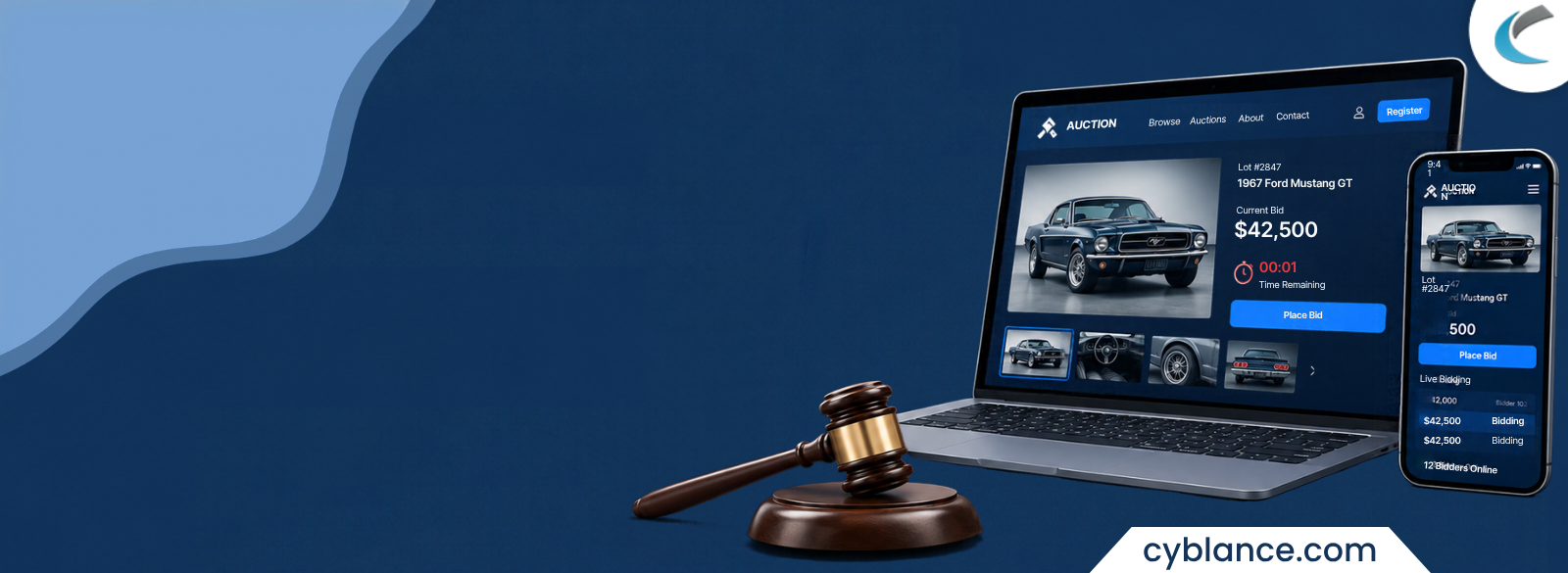
Give people literally anything scarce; a plot of land, a rare bottle of wine, a slightly dented 1967 Mustang, a signed jersey, and eventually someone’s going to want to sell it to the highest bidder while a room full of people quietly sweat it out. Auctions are one of the oldest sales mechanisms on record, and one of the only ones where the price gets decided live, in public, updating by the second, with everyone watching everyone else blink first.
What hasn’t changed is the psychology. The last-ten-seconds adrenaline spike is identical whether you’re holding a paddle in a tent or thumbing your phone at midnight. What has changed is everything behind the curtain; real-time bidding engines, digital escrow, mobile-first catalogs, automated invoicing, KYC checks that stop a fake bidder before they ever place a bid. Running a serious auction business today means running serious software, and choosing how to get that software is not a small decision.
That’s the gap this guide is for. More businesses than ever are launching their own branded auction platforms, auto dealers, real estate firms, art houses, charities, government agencies clearing surplus equipment, even niche collectors’ marketplaces, and most of them are weighing the same three paths: build it in-house, license an existing platform, or bring in a development partner to build something custom around how they actually work. Get it wrong and it’s an expensive thing to unwind once bidders, sellers, and payment data are already living inside it.
Below is a rundown of some of the more established names building auction software today, including us, Cyblance, where our work in this space actually comes from, and what’s worth weighing before you commit to any of them.
Table of Contents
- How We Sized Up the Field
- The Lineup at a Glance
- 1. Cyblance Technologies
- 2. Geomotiv
- 3. AuctionMethod
- 4. AuctionMobility
- 5. Briskon
- 6. RainWorx (AuctionWorx)
- 7. Auction Software (AuctionSoftware.com)
- 8. Dev Technosys
- How They Stack Up
- What Actually Matters When Choosing a Partner
- Which One’s Right for You?
- Wrapping Up
- Quick Questions, Straight Answers
- The Fine Print
How We Sized Up the Field
Auction platforms live or die on details that never show up in a homepage screenshot; how a proxy bid resolves a tie, what happens when a payment fails mid-auction, whether a soft-close extension actually fires when someone snipes a bid in the last second. We looked at each company against seven criteria, based on what each one documents publicly about itself:
- Auction-domain specialization: is auction software the core business, or one product line inside something broader?
- Bidding engine & real-time performance: how does the firm describe handling concurrency, proxy bids, reserves, and soft-close logic?
- Customization model & ownership: do you get a fully custom build with source code in your name, a configurable SaaS product, or a licensed platform you self-host?
- Compliance & vertical-specific features: title-transfer workflows, KYC/bidder verification, escrow, tax handling: the operational stuff that matters once real money moves.
- Integration ecosystem: payment gateways, CRM, accounting, analytics, and how open the platform is to whatever you already run.
- Time-to-launch & pricing clarity: how fast can you realistically go live, and is the pricing model (flat fee, per-lot, license, custom quote) clear up front?
- Support model & track record: what happens when something breaks mid-auction, and what do verified clients actually say afterward?
The Lineup at a Glance
| # | Company | Engagement Model | Best For |
| 1 | Cyblance | Fully custom-built, white-label, source code & data owned by client | Auction businesses that want a platform they own outright, from fast white-label launches to large, ground-up enterprise builds, with compliance features built in |
| 2 | Geomotiv | Custom development, dedicated teams, staff augmentation | Enterprises that want auction software as part of a larger custom-software relationship |
| 3 | AuctionMethod | Cloud SaaS with a custom-development path | US liquidators and auctioneers who want a flat monthly fee, no-commission platform, fast |
| 4 | AuctionMobility | White-label SaaS, backed by a public auction-marketplace group | Auction houses that want live simulcast bidding and native mobile apps out of the box |
| 5 | Briskon | Proprietary auction framework + broader digital-agency services | Businesses that want auction software bundled with digital marketing and IT services |
| 6 | RainWorx (AuctionWorx) | Licensed, self-hosted platform with developer extension points | Teams with in-house developers who want to own and extend the platform themselves |
| 7 | Auction Software (AuctionSoftware.com) | Productized multi-format platform, backed by Liquidity Services | Operators who want several auction formats: forward, reverse, penny, silent, from one vendor |
| 8 | Dev Technosys | Generalist custom web & mobile development | Buyers who see auction functionality as one feature inside a larger, non-auction app |
1. Cyblance Technologies
The specialist that grew up inside real auctions
Founded: 2011, Ahmedabad, India · Auction focus since: 2014 · Serves: USA, UK, Australia, and international clients
Cyblance didn’t set out to become an auction company. It started in 2011 as a general web development shop building custom sites across industries; the usual mix of business services, retail, and e-commerce work. That changed in 2014, when the team picked up its first auction platform project and got pulled into the mechanics of real-time bidding, seller management, and auction-specific workflows in a way that ordinary web projects never demanded. That project became a genuine specialty: Cyblance’s project mix shifted steadily toward auction and e-commerce work in the years that followed, and today the company builds almost nothing but auction and e-commerce platforms; every engineer on the team works inside that domain rather than splitting time across unrelated verticals.
That focus shows up in the product itself. Cyblance’s white-label auction platforms are built around how real auctions actually run, not generic marketplace logic with a countdown timer bolted on:
- Real-time bidding engine, load-tested for high-volume events, supporting live, timed, sealed, reverse, and hybrid/Dutch-style auctions
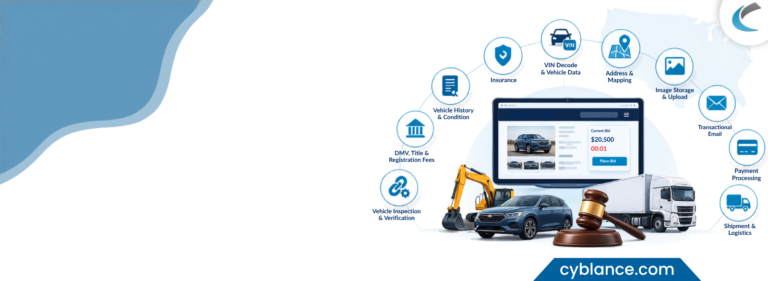
- DMV & e-title compliance and VIN-verification workflows for vehicle auctions
- KYC / bidder verification, with manual admin review and profile checks before anyone can place a bid
- SSL encryption with escrow-integrated payments, plus out-of-the-box support for Stripe, PayPal, and US ACH transfers (additional processors available for enterprise clients)
- Mobile-first, PWA bidding — no app download required for bidders
- 100% white-label branding — client’s own domain, logo, colors, and email templates
- Full source code and bidder-data ownership, transferred at launch, with no vendor access afterward unless support is requested
- WCAG 2.1 AA–targeted accessibility across bidder-facing screens
- Sales-tax handling via Stripe Tax or Avalara integration, nexus-aware for multi-state US sellers
- Hosted on AWS (US region), with data residency confirmed for US-facing platforms
Built for the niche you actually run
Cyblance has shipped platforms across a genuinely wide range of auction verticals: auto and vehicle auctions, real estate, art and luxury goods, heavy equipment and industrial machinery, charity and nonprofit fundraising, estate sales, government and seized-asset disposal, livestock and agricultural auctions, wine and spirits, jewelry, sports collectibles, and marine and boat auctions. Each of those comes with its own quirks, DMV titles for auto, MLS integration for real estate, provenance tracking for art, and building those in from the start is a big part of what “specialist” actually means in practice.
How an engagement actually runs
Cyblance uses a five-step process: discovery and planning (understanding the business model and building a technical blueprint before writing a line of code), proposal and scoping (milestones, deliverables, and cost laid out up front, no surprises), design and development (UI/UX, frontend, backend, and integrations, with continuous client feedback along the way), testing and QA (manual QA, load testing, security checks, payment workflow validation, and user acceptance testing), and launch and support (monitoring, maintenance, and ongoing improvements after go-live). For a more templated white-label build, most clients are live in 6 to 14 weeks; Cyblance cites an 8-week launch on the faster end of that range for a fairly standard configuration. A large, fully bespoke enterprise build, like the case studies below, naturally takes longer than that standard window, but still tends to move faster than an in-house team starting from zero, since the bidding-engine fundamentals aren’t being invented from scratch, compared with the 6-to-18-month range typical of building something equivalent entirely in-house.
What the results actually look like
Cyblance backs this up with named, public case studies rather than vague claims, each one a fully custom build engineered around that client’s specific business, not a reskinned template:
- For a Minnesota-based auto auctioneer stuck on a generic, third-party auction platform, Cyblance architected a fully custom ecosystem from the ground up; bidding, dispatch, payments, and delivery tracking connected as one system rather than bolted-together tools. Within the first six months, the client reported strong sales volume across thousands of vehicles, a large base of verified buyers onboarded through automated ID checks, a sharp drop in fraudulent bidding activity, faster-running auctions, and lower operating costs, with the client now owning the buyer relationship instead of renting it from a third-party platform.
- For a Michigan-based antique and fine-art auction house, Cyblance replaced a business run on phone calls, messages, and spreadsheets with a custom platform built from scratch around how the business actually operated; live, timed, and absentee bidding unified in one system. The client reported a significant cut in manual coordination work, the ability to support several times more concurrent bidders with no notable performance issues, and post-auction processing time down from multiple days to a few hours.
- For a US-based startup building a niche online marketplace for collector and enthusiast vehicles, Cyblance engineered a Dutch-style (descending-price) bidding engine from scratch, a format that isn’t available on most off-the-shelf or white-label platforms, designed around the client’s own auction mechanics rather than adapted from an existing template.
Client feedback on Clutch shows Cyblance holding a consistently high rating, with comments echoing the same themes: responsive project management, genuine adaptability to changing requirements, and a team that clients describe as feeling like an extension of their own staff rather than an outsourced vendor. One recent reviewer, the president of an art gallery running live and online auctions, specifically praised the team’s ability to handle unexpected challenges and its thorough QA process.
Best for: Auction businesses of every size, from first-time operators wanting a fast white-label launch to established auction houses and enterprises that need a large-scale platform engineered from the ground up around their own workflows, all with compliance and vertical-specific features built in from day one.
2. Geomotiv
The Swiss Army knife of software shops
Founded: 2010 · Headquarters: Alexandria, VA, USA (with offices in Lisbon, Yerevan, and Dubai)
Geomotiv is a custom software development company with a genuinely broad range, AdTech, MarTech, OTT and streaming, retail media, and e-commerce are all core practice areas, and auction and bidding platforms are one specialty it’s built a dedicated team around. The company reports more than 200 in-house engineers with an average of eight-plus years of experience, and its documented integration work connects auction platforms to payment gateways, CRM systems, inventory management, marketing automation, and analytics tools, the kind of breadth that shows up when a firm has spent a decade wiring software into other software.
For auction buyers, that translates into real flexibility: Geomotiv will build a platform fully from scratch, customize a white-label starting point, or simply extend your team through dedicated developers or staff augmentation if what you need is engineering capacity more than a finished product. One proof point worth noting, per Geomotiv’s own published case study: a custom B2C trade auction platform it built for a retail client reportedly ran more than 1,600 marketing campaigns in its first two years while holding 99.9% uptime.
Best for: Enterprises that want their auction platform delivered as part of a broader, ongoing custom-software or dedicated-team relationship.
3. AuctionMethod
Built by auctioneers, for auctioneers
Founded: 2012 · Headquarters: Shelburne Falls, MA, USA
What makes AuctionMethod distinctive is where it came from: a family already running an auction business who got tired of stitching together invoicing, payments, and reporting tools, and decided to build something better themselves. That auction-operator DNA runs through the whole product. AuctionMethod offers a cloud-based platform with flat monthly pricing and no commissions or per-lot fees, many teams are reportedly live within days, alongside a custom-development track for auctioneers and liquidators whose workflows need more than the standard product covers.
It’s the unglamorous-but-essential details where AuctionMethod’s auction-operator roots really show: consignor statements with automatic commission calculations, chargeback mitigation, sales-tax handling with reseller exemptions, and a dedicated mobile app for field cataloging and checkout. The company backs it with a public uptime status page and reports a high client renewal rate, which is a good sign that whatever it’s doing, auctioneers are sticking around for it.
Best for: US-based auctioneers, estate liquidators, and equipment sellers who want a proven, transparent-pricing platform with room to customize later.
4. AuctionMobility
The simulcast pioneers
Founded: 2013 · Headquarters: Boston, MA, USA (today part of the publicly listed Auction Technology Group)
AuctionMobility made its name solving a genuinely hard problem: letting a bidder on their phone participate in a live, in-the-room auction with essentially no lag. Its white-label platform pairs sub-second-latency simulcast bidding with native iOS and Android bidder apps, and it documents a specific integration workflow that lets auction houses cross-list a timed catalog to LiveAuctioneers while keeping bids synchronized across both systems in real time.
The company reports serving auction houses across real estate, wine, art, and collectibles in a number of countries. AuctionMobility became part of the publicly traded Auction Technology Group in 2020, a matter of public record through ATG’s own investor disclosures, giving it the backing and continued investment of a larger, established player in the online auction industry.
Best for: Established auction houses that want live, hybrid (in-room plus online) bidding and native mobile apps without building either from scratch.
5. Briskon
The one-stop shop that also handles your marketing
Founded: 2005 · Headquarters: Bengaluru, India (with a presence in Dallas, TX)
Briskon is a nearly 20-year-old digital services company whose work spans SEO, PPC, and content marketing alongside custom software and mobile app development, and online auction software is one of its dedicated specialty products, built around a proprietary “e-auction framework” designed to get a feature-rich platform live quickly.
Briskon covers forward, reverse, silent, and hybrid auction formats, with a particular strength in procurement-style reverse auctions, supplier onboarding workflows and audit-log features that matter for regulated or compliance-sensitive buying processes. For a business that wants its auction platform built and then actively marketed to the right audience, Briskon’s combined software-plus-digital-marketing model is a genuinely useful bundle under one roof.
Best for: Organizations, especially in procurement and B2B reverse auctions, that want auction development bundled with digital marketing from a single long-term partner.
6. RainWorx (AuctionWorx)
The veteran that’s been around since before “unicorn” meant a startup
Founded: 2002 · Headquarters: United States
RainWorx Software makes AuctionWorx, one of the longest-running branded auction platforms still actively sold today; it predates most of the companies on this list by a decade or more. Rather than a custom build, AuctionWorx is licensed as a one-time-fee, self-hosted product with no ongoing commission or per-listing fees, and it’s built specifically with developers in mind: MVC-level source access, provider-based extension points, and API access let an in-house team or implementation partner shape the platform well beyond its out-of-the-box configuration. It also supports a genuinely long list of languages, from Arabic and Dutch to Swedish and Portuguese, making it a practical option for auction operators running multilingual or international audiences.
That longevity and openness has earned real loyalty: AuctionWorx holds a strong rating across dozens of reviews on Capterra.
Best for: Auction operators with in-house development resources (or a trusted implementation partner) who want to own a proven platform outright rather than pay ongoing fees.
7. Auction Software (AuctionSoftware.com)
The Swiss-army platform for every auction format
Founded: 2015 · Headquarters: Richardson, TX, USA (part of Liquidity Services since February 2025)
AuctionSoftware.com built its reputation on breadth of format: forward, reverse, penny, and silent auctions are all supported on one platform, backed by a strong cataloging system and automated invoicing and inventory management across multiple marketplaces at once. The company reports having delivered auction marketplaces for clients across retail returns, automotive, sports collectibles, real estate, and government sectors, a genuinely wide range of use cases for one platform to cover well.
AuctionSoftware.com joined Liquidity Services, the publicly traded parent of GovDeals and other surplus-marketplace brands, in February 2025, an acquisition Liquidity Services announced publicly at the time. That gives it the backing and infrastructure of a much larger organization already deep in the surplus and circular-economy marketplace world, adding a layer of long-term stability for buyers evaluating it.
Best for: Operators who want several different auction formats supported on a single platform, backed by an established parent company.
8. Dev Technosys
The generalist that can build almost anything
Founded: 2010 · Headquarters: Jaipur, India (with additional offices, including in the US and UAE)
Dev Technosys describes itself as a large, ISO 9001:2015–certified web and mobile development company with a broad portfolio spanning fintech, healthcare, logistics, and beyond, and auction or bidding functionality is one type of feature it builds as part of that wider practice. The team covers the full stack in-house, from business analysis and UI/UX design through Android and iOS development and QA, which makes it a capable option when the ask is broader than “just” an auction platform.
For a business whose auction need is really one module inside a bigger product, say, a marketplace app that includes an auction-style listing option alongside standard fixed-price sales, Dev Technosys’s generalist range and ISO-certified delivery process make it a practical, cost-efficient partner to bring the whole thing together.
Best for: Buyers who need general web and mobile app development, with auction or bidding functionality as one feature within a larger product.
How They Stack Up
| Company | Founded | Headquarters | Engagement Model | Known For |
| Cyblance | 2011 | Ahmedabad, India | Fully custom-built, white-label; source code & data owned by client | Compliance-ready, vertical-specific auction builds |
| Geomotiv | 2010 | Alexandria, VA, USA | Custom build, dedicated teams, staff augmentation | Broad engineering bench across many industries |
| AuctionMethod | 2012 | Shelburne Falls, MA, USA | SaaS (flat fee) + custom-dev path | Auction-operator-built, flat no-commission pricing |
| AuctionMobility | 2013 | Boston, MA, USA | White-label SaaS (part of Auction Technology Group) | Live simulcast bidding + native mobile apps |
| Briskon | 2005 | Bengaluru, India | Proprietary framework + broader digital agency | Fast deployment, reverse/procurement auctions |
| RainWorx (AuctionWorx) | 2002 | United States | Licensed, self-hosted platform | Longest track record, deep developer extensibility |
| Auction Software | 2015 | Richardson, TX, USA | Productized multi-format platform (part of Liquidity Services) | Widest format range — forward, reverse, penny, silent |
| Dev Technosys | 2010 | Jaipur, India | Generalist custom web & mobile development | Full-stack generalist for broader product builds |
Cyblance’s white-label model, at a glance
Beyond how each company positions itself, the underlying commercial model matters just as much. Here’s a simple way to picture Cyblance’s white-label approach next to the two other common paths — a typical off-the-shelf auction SaaS product, and building a platform entirely in-house:
| Capability | Generic Auction SaaS | Cyblance White-Label | Build In-House |
| Branding ownership | Often shared or limited | 100% yours, on your own domain | Fully yours, but you build it |
| Live + timed bidding | Frequently separate add-on modules | Both included, no add-ons | Complex to build from scratch |
| Fee structure | Per-lot or commission-based, typically | Flat pricing, no per-lot fees | No vendor fees, but high build/infra cost |
| Source code & data ownership | Rarely fully transferred | Fully transferred at handover | Fully yours from the start |
| Time to launch | Fast, but limited to a template | 6–14 weeks for a tailored build | 6–18 months, typically |
| KYC / bidder verification | Often limited | Manual admin verification with profile checks | Has to be built from zero |
What Actually Matters When Choosing a Partner
Specialization is worth paying attention to. Plenty of teams can build a working bidding page. What’s harder to bolt on later is deep familiarity with how real auctions actually behave, tie-breaking on simultaneous bids, what a soft-close extension should do when someone snipes at the last second, how a consignor gets paid when a buyer disputes a charge. Ask any prospective partner how many auction platforms they’ve actually shipped, not just whether they can build one.
Know what you’ll actually own. SaaS platforms, licensed products, and custom builds all answer “who owns the source code and bidder data when this relationship ends?” differently. Get that answer in writing before you sign anything.
Bidding logic should be specific, not hand-wavy. A good partner can describe exactly how proxy bidding, reserves, buy-now pricing, and soft-close extensions work, and how the system behaves under real concurrent load during a closing-time rush.
Compliance isn’t optional in regulated verticals. Vehicle auctions need title-transfer workflows; government-asset auctions need public-notice and audit-trail features; real estate auctions often need MLS integration and digital contract support. None of that comes free with generic e-commerce logic.
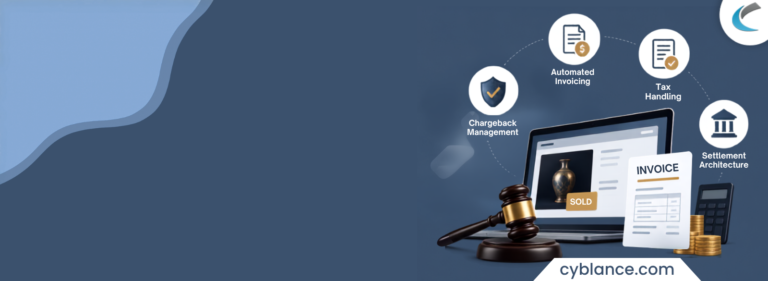
Settlement matters as much as bidding. Invoicing, tax handling, chargebacks, and offline-payment exceptions determine how much manual cleanup your team does after every auction closes. Ask to see this workflow, not just the bidding screen.
Time-to-launch and pricing model should be clear up front. Flat fee, commission, per-lot, or one-time license all carry very different long-term economics depending on your auction volume, model out a real year of usage before comparing sticker prices.
Which One’s Right for You?
Every company on this list is genuinely good at something specific. Here’s a quick gut-check:
- Want a platform you own outright, with US-market compliance features built in — whether that’s a fast white-label launch or a large custom build engineered from the ground up? That’s the case Cyblance is built around.
- Have in-house developers who’d rather own infrastructure than pay recurring fees? RainWorx’s AuctionWorx is a proven, well-loved option worth a serious look.
- Want a managed SaaS product from a large, well-capitalized auction-industry group and don’t need heavy custom workflow changes? AuctionMobility or AuctionSoftware.com fit that brief well.
- Does your auction really need one piece of a bigger custom-software or enterprise engagement? Geomotiv or Briskon can fold it into a broader relationship.
- Comfortable with a generalist agency handling a wide range of app types, not specifically auctions? Dev Technosys is a solid, capable fit.
- Want flat-fee, no-commission US SaaS with an optional custom path, from a team that’s actually running auctions? AuctionMethod is purpose-built for exactly that.
Wrapping Up
The auction software market has genuinely different types of companies solving genuinely different problems, licensed platforms, SaaS products, generalist agencies, and specialist developers all show up in the same search results, and none of them are interchangeable. The right pick depends less on any single “best of” list and more on what you actually need to own, how fast you need to launch, and how much of the operational complexity behind a real auction, compliance, settlement, bidder trust, you want a partner to have already solved before your first sale goes live.
We think Cyblance is the strongest fit for most auction businesses that want a build-from-scratch, own-it-outright platform, and that’s genuinely why we put ourselves first. But “best for you” is a narrower question than “best overall”, talk to more than one company on this list before deciding, including us.
Quick Questions, Straight Answers
White-label software is a pre-built platform that gets configured and re-branded for you, fast to launch, working within the vendor’s existing architecture. Custom development builds workflows, integrations, and UI from the ground up around how your business actually operates. Cyblance’s white-label product sits closer to the custom end of that spectrum: a proven core that gets built out and fully re-branded, with source code transferred to the client, rather than a shared multi-tenant SaaS product.
It varies a lot by model. Licensed platforms like AuctionWorx are typically a one-time fee. SaaS products like AuctionMethod or AuctionMobility charge flat monthly or per-user fees, sometimes in feature tiers. Fully custom builds are usually quoted per project based on scope. Get a specific quote for your actual feature list rather than comparing advertised starting prices, which rarely reflect a real-world build.
A configured SaaS product can go live in days. A tailored white-label build, like Cyblance’s more templated option, typically takes 6 to 14 weeks. A large, fully custom platform takes longer, an in-house team starting from zero often needs 6 to 18 months, while a specialist partner handling the same scope (like the bespoke case studies above) can usually move faster than that, since the bidding-engine fundamentals aren’t being built from scratch.
Licensing (AuctionWorx) or subscribing (AuctionMethod, AuctionMobility) gets you to market fastest and can be the more cost-effective route for straightforward, standard-format auctions. Custom development tends to make more sense when your workflows, compliance requirements, or branding needs go beyond what a template can configure around, which is common in verticals like vehicle, real estate, or government auctions.
It depends a lot on the vertical: vehicle auctions need DMV/e-title workflows and VIN verification; real estate auctions often need MLS integration and digital contracts; nonprofit and government auctions may need public-notice and audit-trail documentation. KYC/bidder verification and escrow-backed payments matter across nearly every vertical where real money and trust are involved.For US B2B buyers specifically, accessibility (WCAG 2.1 AA) and state-by-state sales tax nexus.
No, Cyblance is headquartered in Ahmedabad, India, and serves clients across the USA, UK, and Australia, with dedicated features (like DMV/e-title compliance and US timezone support) built specifically for the US market, where a large share of its auction clients operate.
Engagements run on a five-step process with clear milestones (discovery and scoping, design and development, testing and QA, launch and support) and scheduled check-ins, rather than requiring a client to be reachable in real time all day. What doesn’t change regardless of time zone: full source code and bidder-data ownership transfer to the client at launch, and the proposal-and-scoping step puts cost, milestones, and deliverables in writing before work begins.
Yes. Full source code is transferred at launch, and the bidder database belongs to the client. Cyblance has no ongoing access after handover unless support is separately requested.
The Fine Print
This guide is published by Cyblance Technologies Pvt. Ltd., an auction software development company and one of the companies profiled here. The information above is drawn from publicly available sources, each company’s own website, listings on third-party platforms including Clutch, Capterra, G2, Crunchbase, and PitchBook, and published case studies, gathered as of the article’s publish date in 2026. Company offerings, pricing, team size, ownership, and features change over time, so we’d recommend verifying anything that matters to your decision directly with the vendor before signing an agreement. If you believe any factual claim about your company here is inaccurate, please reach out and we’ll correct it promptly. All company and product names are trademarks of their respective owners.