



Building a real-time bidding system is a very complex task due to the fact that the outcome of the system’s fairness, competitiveness, and scalability is influenced by every millisecond. Current real-time auction platforms are greatly supported by modern communication protocols and services like WebSockets, Firebase, and Google Pub/Sub, which together enable instant updates and smooth user interactions.
Why Real-Time Bidding Matters in Auctions
Without doubt, an instant reaction to a competitor’s proposal is the core of real-time bidding. Every bid in a real-time auction must be visible instantly, especially during last-minute bidding surges, soft-close extensions, and reserve-price triggers where milliseconds decide the winner (Cyblance, 14 Technical Challenges in Online Auction Platforms). What is very important in auctions is that the activity of bidders is maintained when people get very excited, which in turn causes more bids and higher final prices. At the same time, if the time lag goes over just 2–3 seconds, online bidders are very much limited in comparison to the ones at the live event, thus the system becomes unfair and unreliable.
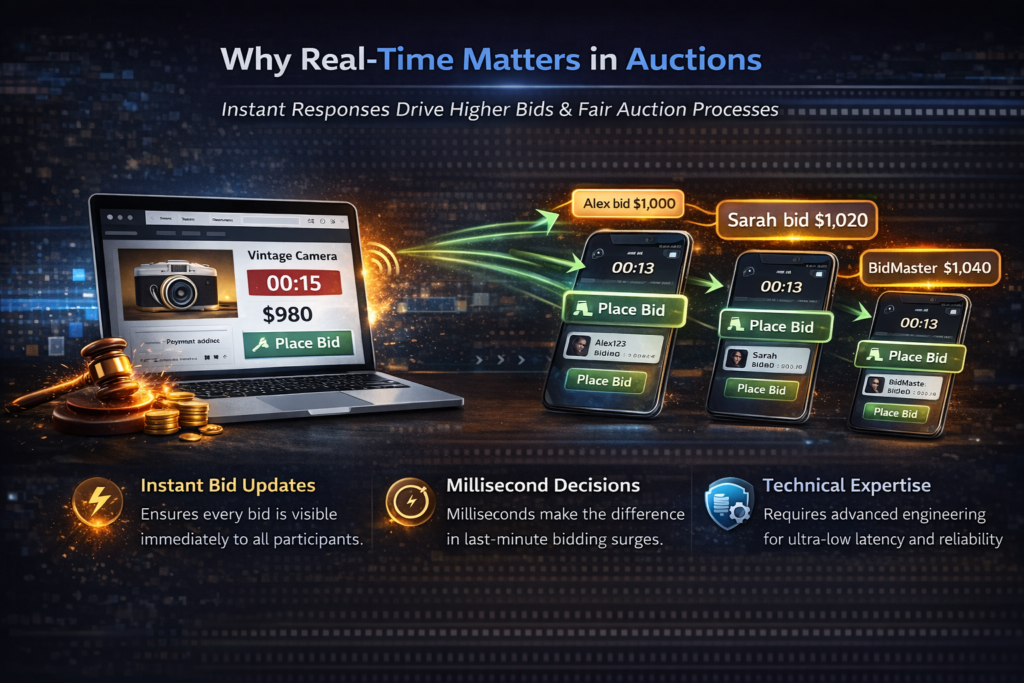
The biggest challenges behind this are deeply technical. To keep tens of thousands of users online simultaneously, to mirror the bid states on different devices, and to keep the response time below one second, a high level of engineering skill is needed. According to Cyblance in their system design guide, “Real-time messaging is the lifeline of any online bidding system.” This one idea explains the reason why the architecture of the system – protocols, frameworks, databases, and event-driven infrastructure – is the main factor that states whether your auction platform is of high quality, trustworthy, and genuinely competitive.
What Real-Time Technologies Do for Bidding
In a real-time auction system, each bid follows a strict flow: validation against the current price, conflict resolution for concurrent bids, state update, and instant broadcast to all connected bidders. As the blog “Top Real-Time Bidding Technologies for Online Auction Websites” points out, a strong real-time bidding system has to broadcast the new bid to all users within a few milliseconds to keep the auction fair and transparent.
And every user, whether on mobile or desktop, must be able to view the very same auction state. Moreover, when thousands of users connect at the same time, the platform should be able to scale without any problems. As Cyblance points out in their high‑traffic auction architecture guide, real‑time synchronization and robust concurrency handling are essential for reliable bidding performance.
(blog: Architecture Blueprint of a High-Traffic Online Auction Platform)
Technology Overview
A. WebSockets
WebSockets are a sustaining, in-depth, bi-directional communication protocol that is a great part of the usage in real-time auction platforms. It is compatible with Node.js, Python, Java, and Go, which makes it very versatile for custom development.
B. Firebase (Realtime Database / Firestore)
Firebase is Google’s local backend solution that is fully managed and hence requires no server intervention. All updates are automatically synchronized across clients.
C. Google Pub/Sub
Google Pub/Sub is a distributed messaging service that uses streams for an event-driven auction system, which is a scalable microservice-based platform solution that requires high data durability and accurate delivery.
WebSockets for Real-Time Bidding

Efficiently broadcasting bid information with low delay
WebSockets give the fastest achievable response time as they keep an open connection between client and server thus no need for reconnection—ideal for real-time updates for auctions.
Pros
The latency is minimal in webSockets, and hence the development team has total freedom in the implementation of custom logic, timing, and conflict resolution. Moreover, they can be easily combined with high-performance stacks like Redis, Node.js, and Go to allow developers to fine-tune bidding engines at an advanced level.
Cons
At scale, WebSocket architectures must handle reconnect storms, uneven connection distribution across nodes, and shared state synchronization when tens of thousands of bidders reconnect simultaneously. WebSockets scaling is not an easy task and requires a large engineering team effort. This point is also supported by the Cyblance blog that mentions in the blog: “High concurrency management is essential when multiple users place bids at the same time.“
Best For
Where engineering teams have to be in complete control, such as in platform development of large-scale auctions or custom rules requiring millisecond-level update cycles.
Firebase for Real-Time Bidding
A managed, auto-scaling real-time backend
Instant synchronization among clients is powered by Firebase, which makes the tool perfect for teams that value speed but want to avoid the hassle of handling infrastructure themselves.
Pros
Firebase’s simplicity makes it powerful for rapid prototyping. The auto-scaling architecture of the service is such that abrupt spikes in the volume of bids are taken care of without the need for intervention. Mobile-first auction startups are typically inclined to opt for Firebase due to its effortless compatibility with iOS and Android SDKs.
Cons
The rise in costs is directly proportional to the frequency of writes, which is a situation that poses a serious problem in auction platform scenarios, where each bid results in the creation of multiple writes. Additionally, the extent to which developers can customize conflict resolution in Firebase is very limited; hence, the platform is less suitable for enterprise-grade real-time bidding architecture that requires complex conflict resolution mechanisms.
Best For
Test builds or MVPs, auctions with little traffic, and developers who do not want to bother themselves with backend maintenance.
Google Pub/Sub for Real-Time Bidding
A distributed event-streaming backbone
Pub/Sub was engineered with a million messages in mind, and great performance is attributed to the system’s durability, reliability, and horizontal scalability of the event-processing.
Pros
Excellent for enterprise-level online auction platform design that requires massive volumes of events to be processed in a reliable manner. Not only that, but Pub/Sub is also very useful for Data Warehouse-centric solutions, as it is very easy to hook up with BigQuery, Dataflow, and Cloud Run.
Cons
Pub/Sub functions best as a backend event backbone for bid processing, auditing, and analytics, while a separate delivery layer, such as WebSockets, handles real-time user updates. Its delay, which ranges from tens of milliseconds, is good enough for event processing but not so for the immediate user-facing bid updates.
Best For
Platforms with high traffic, architectures that employ the use of microservices, and systems at an enterprise level that require message durability.
Performance Comparison Overview
| Criteria | WebSockets | Firebase (Realtime DB / Firestore) | Google Cloud Pub/Sub |
|---|---|---|---|
| Latency / Real-time sync capability |
Very low latency due to persistent bi-directional connection over TCP — ideally enables sub-second updates.
(WebSocket standard, MDN WebSocket API) developer.mozilla.org |
Designed for real-time data synchronization across all connected clients; updates propagate within milliseconds after data change.
(Firebase Docs) firebase.google.com |
Pub/Sub is an asynchronous event/message streaming system; latency depends on message delivery + subscriber processing + client delivery —
not inherently front-end real-time. WebSockets required for real-time UX.
(GCP Pub/Sub Docs) cloud.google.com |
| Scalability |
Highly scalable but requires custom infrastructure: server clustering, load balancers, sticky sessions or connection affinity.
(WebSocket usage guidelines) developer.mozilla.org |
Auto-scaling managed by Google backend. Good option for quickly scaling apps without manual infrastructure setup.
(Firebase Docs) firebase.google.com |
Built for large-scale event throughput, distributed messaging, and many publishers/subscribers.
Best choice for high-volume, enterprise-level systems.
(Pub/Sub architecture docs) cloud.google.com |
| Implementation Difficulty |
Medium–High: Requires backend developer effort — managing connections, scaling, state synchronization, and message routing.
(WebSocket API & server-side notes) developer.mozilla.org |
Low to Medium: Backend infrastructure is abstracted away. Simple SDK/API for real-time sync with minimal server maintenance.
(Firebase real-time sync docs) firebase.google.com |
High: Requires building publisher/subscriber logic, event handling, queue management, and additional delivery layers
(WebSockets or SSE) for front-end.
(Pub/Sub streaming documentation) cloud.google.com |
| Cost & Maintenance Overhead |
Infrastructure cost based on server hardware/cloud compute; scales with number of connections and throughput.
(General WebSocket deployment models) developer.mozilla.org |
Pay-as-you-go managed backend reduces ops costs; heavy read/write traffic increases Firebase usage costs.
(Firebase pricing & usage docs) firebase.google.com |
Pay-per-message/event model; cost-effective for high event volume but requires additional services for storage,
logging, and analytics — adds complexity.
(Pub/Sub pricing & architecture docs) cloud.google.com |
| Storage & Logging / History & Audit Support | Requires custom storage solution (database + logging) since WebSocket is only a communication protocol. |
Built-in database storage + real-time sync + optional offline support; data persistence handled by Firebase backend.
firebase.google.com |
Messaging-only system; persistent storage or analytics logging must be implemented separately
(e.g., BigQuery, Cloud Storage).
cloud.google.com |
| Best Role in Auction Architecture | Front-end bid delivery | Rapid MVP synchronization | Backend event streaming and audit logging |
Choosing the Right Technology
Selecting an appropriate real-time bidding system mainly involves deciding the factors of speed, scalability, control, and platform goals. All the three technologies, namely WebSockets, Firebase, and Pub/Sub, have their advantages in certain situations. Knowing these strengths helps your auction platform to be not only fast and stable but also future-proof.
When to Choose WebSockets: WebSockets would be your option if it is your platform that demands the updates in a blink of an eye, custom bidding logic, or high-energy live auctions, e.g., where utmost control of the backend behavior is extremely vital.
When Firebase Is the Best Choice: Using Firebase would be excellent in the development of MVPs, startup auction apps, or moderate-traffic platforms where the factors of product development speed, real-time sync, and low infrastructure management are crucial ones.
When Pub/Sub Is Required: Pub/Sub should be implemented in the cases of large-scale enterprise architectures, distributed microservices, or a vast network of auctions requiring severe reliability and a massive number of events.
Very often, a combined strategy is the strongest one, whereby WebSockets are utilized for instant delivery and Pub/Sub is responsible for internal event flow for durability and scales. As a matter of fact, Cyblance states in their blog, Top Real-Time Bidding Technologies for Online Auction Websites:”Most of the modern auction platforms adopt a hybrid system with a push channel and a message queue to ensure reliability ”.
Recommended Architecture for Scalable Auction Platforms
The architecture of a modern real-time auction platform that cares about speed, reliability, and handling of bids correctly is built layered.
A typical bid flow follows this sequence:
- Bid received
- Validation and conflict resolution
- State update in Redis
- WebSocket broadcast to users
- Event published to Pub/Sub for logging and analytics
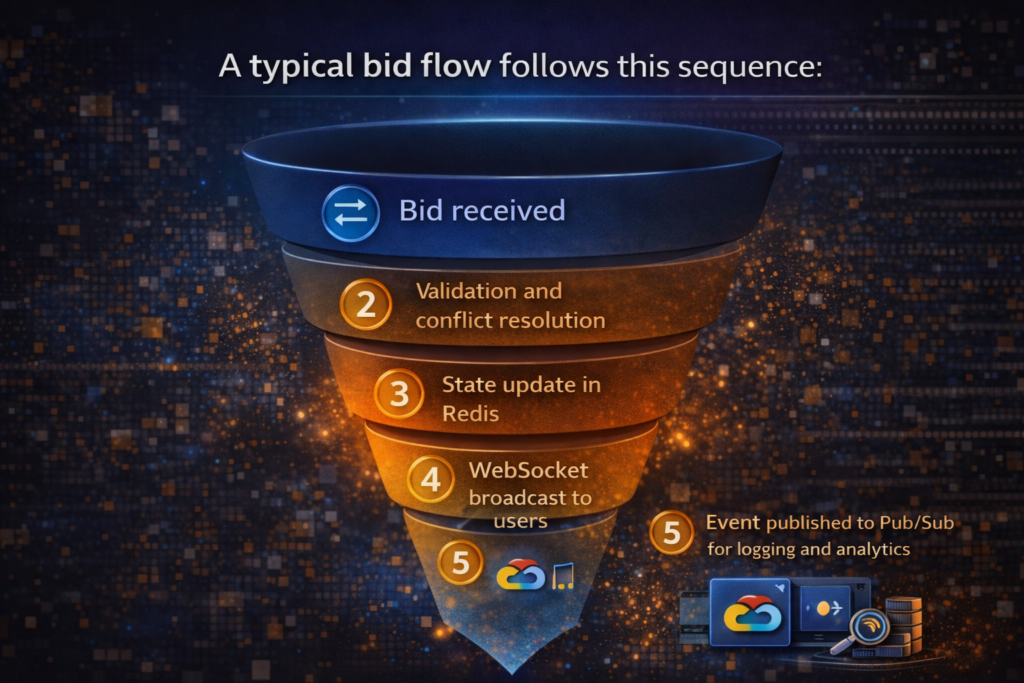
In order to have the platform as fast as possible, Redis cache is used to store the latest bid state in memory, thus allowing instant retrieval for new or returning bidders. This set of technologies is a reflection of the architecture strategies that are used by the top platforms like HiBid and Copart; thus, they are able to guarantee scalability, real-time accuracy, and an excellent bidder experience.
Conclusion
By having the appropriate real-time communication technology for your real-time auction platform, you are essentially making a decision that can either mark your success or failure in the future. WebSockets are the fastest of all, while Firebase is the easiest to use, and Pub/Sub can be your choice if you are looking for enterprise-level scalability. For low to mid-traffic auctions, Firebase accelerates launch. For latency-critical live auctions, WebSockets offer full control. At enterprise scale, a hybrid model combining WebSockets and Pub/Sub delivers both speed and reliability.
If you are a company whose core focus is on the creation of a high-quality, performance-driven bidding experience that generates revenue, then you can consider Cyblance a partner in your development journey, which you can rely on. As the HiBid-style system guide mentions,
“Auction Platforms have to integrate real-time communication backed by robust backend engineering to deliver a seamless bidding experience.”(Source: Building Auction Software Like HiBid)
A strategic architecture today ensures your auction succeeds tomorrow.
FAQs
WebSockets provide a real-time response that is the fastest of all, which is why they are the best alternative for an intense bidding activity. The use of Firebase is appropriate for a small-scale platform and Pub/Sub for an enterprise-scale system.
Indeed. Firebase can handle the real-time sync very well; however, if there are a lot of bid writes, it can become a very costly operation and at the same time introduce limitations in custom conflict resolution.
It is due to the factors that provide the highest reliability, stability, and integration flexibility. It is perfect for being the hub of event-driven architectures that require solid logging and message ordering.
Absolutely. Many large-scale auction solutions at the enterprise level have in place WebSockets that are used for delivering the front-end and Pub/Sub for routing the backend messages and audit logging.
Cyblance is a top auction website development company that is highly proficient with scalable auction platform development, bidding website development, and real-time auction system architecture using the latest technologies.