



Online auction platforms have redefined the transaction world of assets, collectibles, cars, properties, and a multitude of other categories. In contrast to regular eCommerce stores, an auction platform deals with considerably volatile scenarios. It has to handle sudden traffic spikes, fierce real-time interactions, and a flurry of transaction updates all happening within a few milliseconds. The system has to be in a perfect state when hundreds or thousands of bidders are frantically placing their bids just before the timer hits zero. Hence, the architecture of the platform, rather than the features, is what actually supports a high-traffic auction platform.
Modern-day companies demand an auction web platform to seamlessly support 20,000+ users at the same time without any performance degradation or service outage. However, reaching such a scaling level is equivalent to having a carefully planned architectural layout that focuses on speed, reliability, and real-time, uninterrupted performance. And as Cyblance points out in one of its most-read auction blogs:
“Every second matters when users are locked in a bidding war.”
In case you are devising an online, scalable auction platform plan, the strength of your architecture has to be apparent from the very first day. Let’s dissect this idea further to see precisely how such a system needs to be constructed.
1. Introduction
stability and speed aren’t optional—they’re the backbone of credibility. Without a well-planned architecture, even the most feature-rich platform can collapse under sudden load. A strong architectural blueprint ensures the system stays responsive, balanced, and resilient, no matter how intense the bidding activity becomes.
As one Cyblance blog insightfully states:
As a company intending to enter the online auction market, having the correct architectural groundwork will be like a treasure that will keep you safe from the necessity of reworks, downtimes, and scalability crises for years to come.
2. Understanding Auction Platform Architecture
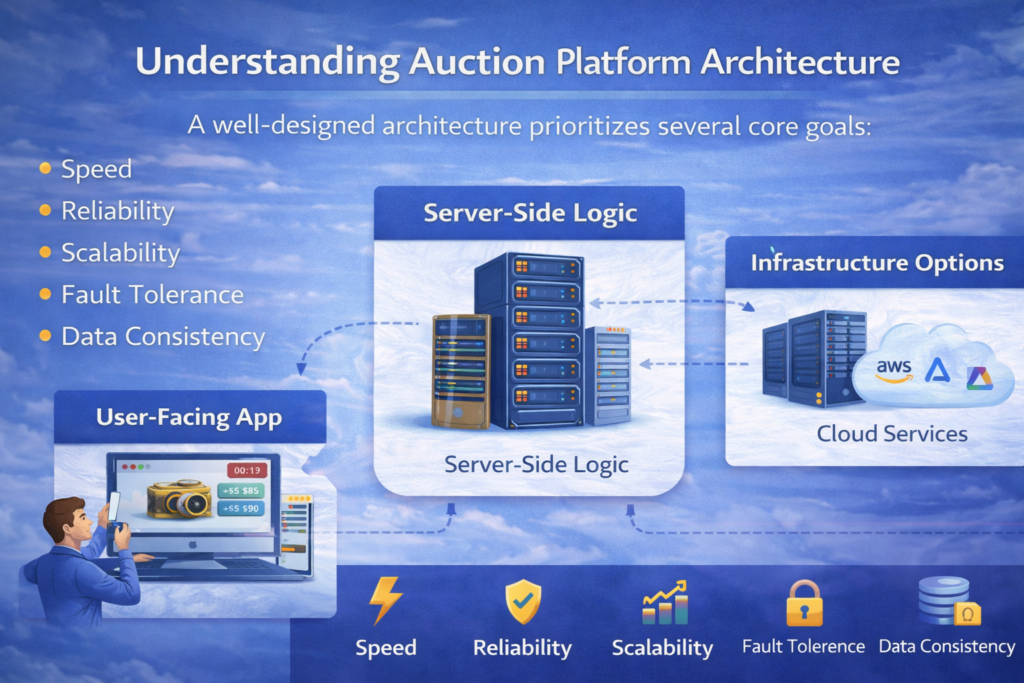
An auction platform’s architectural design illustrates the collaboration of all elements—starting from the user-facing application and going through the server-side logic and the hardware or cloud services supporting it—to provide a seamless and up-to-date flow of operations.
A well-designed architecture prioritizes several core goals:
- Speed: In order to keep the users updated with the fresh news from the market, the company shall react and notify of any bid changes in an instant.
- Reliability: Any interruption during the auction time is rigorously prohibited and causes immediate revenue decrease.
- Scalability: The system should expand effortlessly as user traffic grows, especially during peak bidding hours.
- Fault Tolerance: The design should keep working even if a part of the system is broken or one or more services are not operational.
- Data Consistency: Every bid should be exact, have no contradictions, and safely stored.
3. Core Components of a High-Traffic Auction Platform
Building an online auction platform that can grow and withstand heavy traffic is like a different layers working smoothly together. These are the essential parts and the ways they help the auction activities to be live.
a. Frontend Layer
The frontend is the medium where the users get to live the thrill of live auctions, hence, it has to bring the updates in real-time, without any waiting time or interruptions. To create fast and user-friendly interfaces featuring live dashboards, countdown timers, and continuous bid updates, modern auction platforms utilize technologies such as React, Angular, Vue, and Next.js. Real-time interaction is generally done via WebSockets or Server-Sent Events (SSE), thus ensuring that the changes in bids and updates in timers are visible instantly on every device.
As a result of numerous bidders using smartphones, the frontend should be not only fully responsive but also lightweight in order to deliver a pleasant experience to users of all screen sizes. As stated in Cyblance’s bidding guide: “Auction bidding can be implemented through plugins, third-party apps, or fully custom development—your choice depends on the business model of your platform.”
b. Backend Layer
The backend is the part of the system that handles all the business logic. It includes bid processing, user authentication, auction management, notifications, and more.
Big auction websites follow an API-first strategy in order to keep the frontend and backend parts separate and allow them to be changed or developed independently. To handle the backends of the services which are overwhelmed with the sudden spike of transactions in a live bidding event, they employ queuing systems like Kafka, RabbitMQ, or AWS SQS.
Cyblance captures this concept effectively in its blog on real-time bidding technologies:
c. Database Architecture
The database layer is the core component of an auction system that keeps track of such sensitive information as bids, users, auction items, and transaction records.
The data of a high-traffic auction platform cannot be stored in one database only. To distribute data, a system that is both distributed and replicated is used in several nodes like PostgreSQL, MongoDB, MySQL clusters, or Cassandra.
Bid processing must be done in a way that data consistency is maintained; thus, every update should be correctly reflected in real time.
d. Real-Time Bidding Engine
The real-time bidding engine is the focal point of the whole auction system that handles the requests for bid validation, the application of increment rules, the management of auction timers, and the determination of winners. It is an obligatory function to perform every operation in a snap and to ensure that all bidding events are the ones that follow up in the correct sequence.
The engine, therefore, conducts the immediate bid checks, keeps the timers synchronized, makes updated bid values available to the users within a few milliseconds, and carries out atomic updates to eliminate the possibility of race conditions. The great majority of platforms for scalable auctions are built on technologies such as Google Firebase, WebSockets, Redis Pub/Sub, and Kafka Streams, which are at the users’ disposal for both speed and accuracy.
e. Caching & Performance Optimization
In peak hours, it is very important that caching is used to speed up the process and lessen the load on the server. Querying time is significantly lowered, and thus, fetching of static and semi-static data like pictures, auction lists, and user sessions becomes much more rapid, which is ensured by the use of caching services such as Redis, Memcached, or Cloudflare CDN.
What is more, the use of load balancing tools such as Nginx, HAProxy, or AWS ELB helps in the distribution of user traffic in a way that no single server gets overly loaded.
f. Cloud & Scalability Setup
Where auction innovation meets its future, cloud-powered, environmentally friendly platforms like AWS, Google Cloud, and Azure are what modern auction platforms are all about.
Some of the key things that a platform does to prepare for the future are:
- Horizontal scaling, so that there can be more server utilization, is very high, and the need for traffic grows
- Using Kubernetes and Docker for container orchestration
- Creating auto-scaling groups that can adjust depending on the CPU or memory usage
- Having an application running in different regions to shorten the distance to the user and thereby reducing latency
g. Security Layer
Auction platforms are at the center of handling monetary data, user info, and very sensitive trade records; thus, they have to put in place very strong and tight security measures, which are a must.
The main security layers that are usually in place are:
- User authentication via OAuth 2.0 or JWT
- Full encryption and SSL certificates
- Secure payment gateways are done by tokenization
- DDoS protection through cloud firewalls and rate limiting
- Permanent vulnerability checking with the use of AWS Inspector-type tools
h. Analytics & Monitoring
It is indispensable for a high-traffic auction platform to have monitoring tools to keep the operation smooth and also to spot any system problems before they have a negative effect on the users. These measurement solutions, like Prometheus, Grafana, Datadog, and AWS CloudWatch, contribute to the real-time tracking of the most vital performance metrics such as latency, uptime, concurrent active users, and bid success rates. A correct monitoring installation enables developers to locate irregularities in a short time; thus, they can avoid the time when the system will not be working, and still allow the bidding to go on smoothly, even when the traffic is at its highest.
4. Scalability Strategies for 20,000+ Users
Handling over 20,000 concurrent users necessitates careful planning and robust architectural strategies.
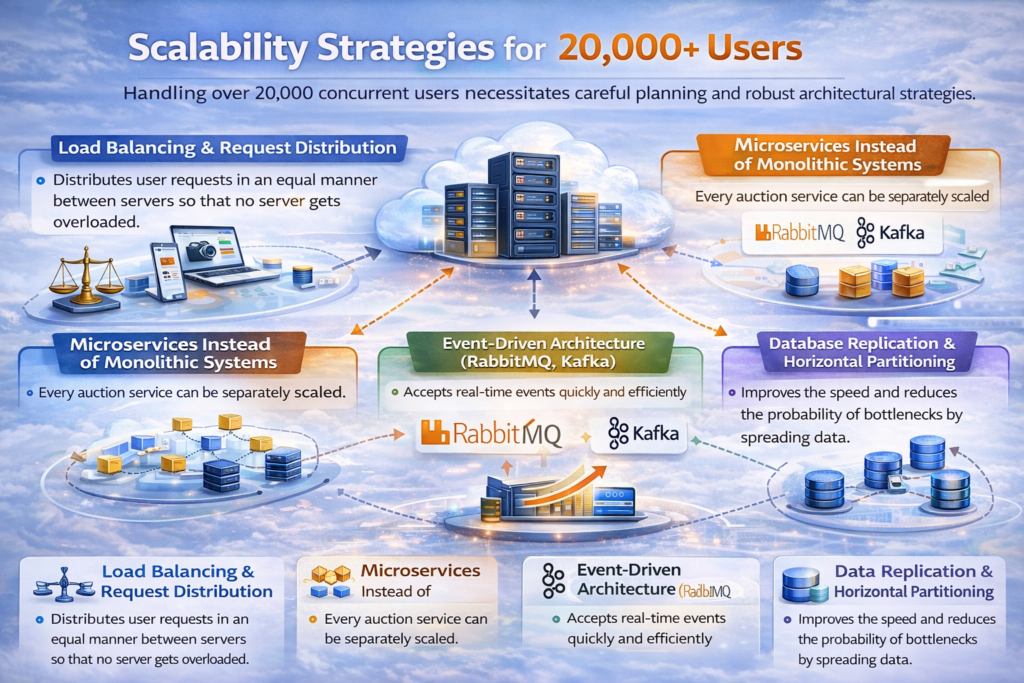
- Load Balancing and Request Distribution: Distributes user requests in an equal manner between servers so that no server gets overloaded.
- Microservices Instead of Monolithic Systems: Every auction service can be separately scaled.
- Event-Driven Architecture (RabbitMQ, Kafka): Accepts real-time events quickly and efficiently.
- Auto-Scaling Triggers Based on CPU/Memory: The resources are scaled up automatically when there is a sudden spike in traffic.
- Database Replication and Horizontal Partitioning: Improves the speed and reduces the probability of bottlenecks by spreading data.
5. Example Architecture Diagram (Conceptual)
A typical high-performance auction platform architecture may look like this:

This structure ensures fluid communication between all components while maintaining high availability.
6. Challenges & Best Practices
Designing a high-traffic auction platform comes with various challenges. Below are key issues and few strategies for addressing them.
Handling Bidding Collisions
A bidding collision is a situation when two or more users attempt to place their bids at the same time. One of the ways to achieve the system’s awareness that only one bid has won is a combination of atomic updates and message queues.
Maintaining Data Integrity
Data consistency in distributed systems requires very careful handling. Distributed locking and timestamp ordering techniques ensure accuracy.
Reducing Latency
Latency in tightly contested auctions can be reduced to a great extent by using CDNs, caching layers, global servers, and lightweight APIs.
Backup and Disaster Recovery Planning
The platform that you are running can be saved from sudden downtime by scheduling backup regularly, implementing failover systems, and multi-zone deployments.
7. Tools & Technologies Recommended
Frontend
Backend
Node.js, NestJS, Laravel, Django
Databases
Server Infrastructure
AWS EC2, AWS S3, CloudFront, Kubernetes
CI/CD & Monitoring
Jenkins, GitHub Actions, Prometheus, Grafana
8. Conclusion
An excellent design or attractive items alone are not sufficient for a high-traffic auction platform. It needs a robust architecture that is fast, scalable, reliable, and capable of operating in real-time. With a solid foundation, your platform can grow without running into bottlenecks, be able to support more than 20,000 users at the same time, and constantly deliver smooth bidding experiences.
Cyblance is a specialist in auction website development, the implementation of real-time bidding, and the architecture of a scalable auction platform. The foundation for your platform is the first step to be able to follow the global leaders.
Get a free consultation on designing your high-performance auction system with Cyblance.
FAQs
A properly optimized monolithic architecture can handle around 20,000–50,000 concurrent users with ease. A microservices architecture can scale much higher and, with the right infrastructure, can support 300,000 to 1,000,000+ concurrent users, depending on load-balancing, caching, and hosting capacity.
The best solution for delivering real-time bid updates with very low latency is the use of Google Firebase, WebSockets together with either Redis Pub/Sub or Kafka.
The prevention of bid collisions can be achieved through the use of atomic operations in the database and message brokers to guarantee strict event ordering.
A polyglot solution with PostgreSQL, Redis, and MongoDB gives the best combination of speed, consistency, and flexibility.
Cyblance is the right choice when it comes to the creation of scalable and real-time auction platforms that are supported by their technical skills, which are verified and proven.