


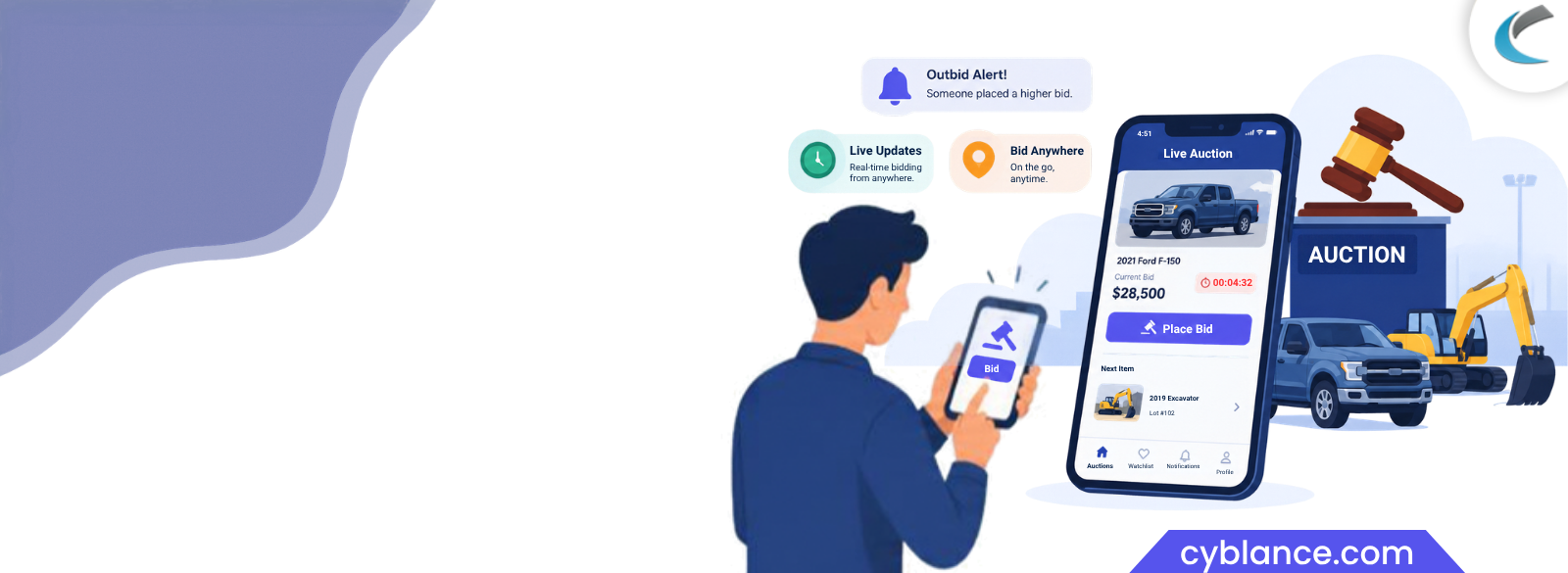
Mobile devices now account for the majority of auction traffic, yet many auction platforms still deliver a desktop-first experience. As bidder expectations shift toward real-time, on-the-go participation, auction companies that invest in mobile-first platforms are seeing higher engagement, more bids, and stronger auction outcomes.
Whether it be the industrial equipment auctions, vehicle, estate, or B2B liquidation marketplaces, buyers nowadays are demanding a smooth bidding experience straight from their phones. They expect instant notifications, real-time access to bidding activity, and a fast, seamless checkout experience.
For auction businesses in the US, purchasing a modern mobile auction platform is not only a technology upgrade anymore but also a competitive business strategy that has a major effect on bidder engagement, retention, and auction revenue.
Statista states that mobile commerce accounts for a large portion of the global online shopping traffic, and auction marketplaces are following the trend.
Here is what we discuss:
- Why mobile-first bidding is taking over the auction industry
- Bidder engagement boosting features
- Technical aspects for scalable auction systems
- Why do auction companies focus their investments on mobile
Why Are Mobile-First Auction Platforms Growing Rapidly?
Mobile-first auction platforms are growing because bidder behavior has shifted dramatically: over 65% of auction traffic now comes from mobile devices, and bidders expect real-time, on-the-go participation.
The 5 key drivers of mobile auction growth in 2026:
- Instant notifications – Bidders expect immediate outbid alerts and auction reminders
- One-tap bidding – Frictionless mobile checkout reduces bid abandonment
- Real-time access – Live countdowns and bid updates from any location
- Anywhere participation – Travel, job sites, and live events no longer interrupt bidding
- Biometric security – Face ID and Touch ID build trust for high-value transactions
Auction companies that fail to optimize for mobile see 30-40% lower bidder retention and significantly reduced final sale prices.
This is particularly the case in heavy equipment auctions, vehicle auctions, industrial liquidation, estate sales and government surplus auctions.
The main advantage auction companies see with mobile is that users are now able to participate even if they are travelling, working, or attending live events.
The Salesforce Shopping Index report points out that mobile users tend to engage more with platforms that provide personalized and real-time interactions.
Mobile optimization is a direct factor for auction companies changing:
- Frequency of bids
- Level of auction participation
- Length of sessions
- Rates of user retention
- Last-minute biddings activity
Those platforms that do not focus on mobile optimization experience lower engagement, along with a higher drop-off rate of users.
The Role of Real-Time Engagement in Mobile Auctions
Successful auctions rely on urgency and competitive bidding. Mobile devices strengthen this experience by delivering instant updates.
Elements like:
- Live countdown clocks
- Outbid signals
- Immediate confirmations
- Reminder of the auction’s end
Increase bidder engagement and participation.
This is where real-time mobile bidding systems provide the greatest value.
In high competition auctions even a slight delay can change:
- Correctness of bids
- Level of user trust
- Value of the final auction
- Overall experience of bidders
In a lot of B2B auction categories, Most bidding activity happens during the final minutes of an auction. Real-time mobile involvement plays a huge role in helping auction companies encourage the most participation during those win-at-all-costs moments.
Features That Drive Engagement
In the auction market, user engagement is crucial for generating revenue, and mobile technology has become a key enabler of effective engagement. As mobile-first auction platforms evolve, several features have taken priority due to their potential to improve bidder participation, increase retention, and overall improve the user experience.
Fundamental mobile auction platform features include:
Push Notifications for Auctions
Among all the communication channels available to modern auction operators, the most powerful avenue for user engagement is undoubtedly push notifications. This real-time form of messaging has grown exponentially in recent years, especially since it doesn’t require the user to open the app or be actively using it to receive messages.
When it comes to auctions, notifications are often used to:
- Warn that a user has been outbid
- Remind that the auction is underway
- Notify users about new auction listings.
- Alert to the final countdown
- Send payment reminders
Illustration:
“You have just been outbid, and the auction closes in 2 minutes.”
Airship Mobile Engagement Research has revealed that personalizing push notifications enhances app engagement as well as reopening rates significantly.
Push Notification Best Practices
- Customize notifications according to bidder preferences
- Do not overload with notifications
- Employ deep linking for redirecting users to live auctions directly
- Send notifications in real time
Well-deployed notification strategies go a long way in increasing bidder retention and auction participation metrics.
One-Tap Bidding Feature
While it might seem like the simplest feature, one-tap bidding is quickly becoming the norm rather than the exception in auction apps.
Every extra step inserted anywhere in the path to placing a bid just serves to increase the chances of a user giving up and abandoning the auction.
A seamless bidding experience includes:
- Auto-saving of payment details
- Biometric verification, such as Face or Touch ID
- Instantaneous bid confirmations
- Optimized loading times
In auctions where multiple bidders are vying for a single lot, convenience and speed:
- Boost bid submission rates
- Enhance user engagement
- Lead to higher repeat usage
- Increase mobile conversion rates
Faster bidding experiences help auction companies increase participation and maximize auction revenue.
Real-Time Countdown Timers
Countdown timers serve the dual purpose of keeping users alert to the passing time and making clear the total time that has elapsed.
To work well, a mobile-first auction app needs to provide:
- Countdown timers synchronized live across different users
- Automatic extensions of auctions if bids come in at the last minute
- Refreshing mechanisms that work in real-time
- Multiple countdown statuses dynamically adjustable inline with live bids
The concept of a “soft-close” is widely recognized as the optimal auction model. By automatically extending the auction time if a bid is placed during the last few seconds, the chances of one party winning by the sneaky tactic of “sniping” are eliminated and the fairness of the competition is heightened.
Real-Time Bid Updates
Modern users will generally value being able to see an accurate real-time representation of the auction.
From the perspective of a seller, this is necessary because:
- It permits monitoring of the highest bid
- It allows auction participants to be kept up-to-date continuously, which means that they are less likely to lose interest and drop out early
- It delivers an opportunity to react and counter-bid
- It helps to keep the auction dynamic and interesting across the board
For this to be possible, the auction must have a robust and scalable real-time bidding infrastructure for the mobile app, making instant update deliveries that reflect the most recent bidding behavior without delays or hiccups.
Real-Time Bid Data Technologies: Which Is Right for Your Auction Platform?
| Technology | Best For | Latency | Scalability | Complexity |
|---|---|---|---|---|
| WebSockets | Live bidding with <500 concurrent users | Ultra-low (<50ms) | Moderate | Low |
| Firebase Realtime Database | Rapid prototyping, small-to-mid auctions | Low (<100ms) | Moderate | Very Low |
| Redis Pub/Sub | High-frequency bid updates, mid-scale platforms | Ultra-low (<20ms) | High | Medium |
| Kafka Event Streaming | Enterprise-grade auctions, 10,000+ concurrent bidders | Low (<100ms) | Massive | High |
Choosing the wrong infrastructure is the #1 reason auction platforms crash during high-traffic closings. Most auction businesses need a hybrid approach, combining Redis for real-time bid updates with Kafka for event logging and analytics.
Get a Free Architecture Recommendation
Tell us your expected bidder volume and auction frequency. We’ll recommend the optimal tech stack for your use case.
Used by industrial equipment, vehicle, and estate auction platforms across the US.
Technical Considerations for Auction App Development
Apart from strong visual appeal, auction app development demands excellent performance, scalability and high levels of reliability.
Responsive Mobile Design
Even an independently functioning mobile app must be able to accommodate various other devices, such as:
- Tablets
- Desktop PCs
- Multiple screen resolutions
The Building Blocks and tools for accomplishing this are currently:
- Flutter – Google’s UI toolkit
- React Native – Facebook’s JavaScript framework
- SwiftUI – Apple’s proprietary UI framework
- Kotlin Multiplatform – JetBrains tool for sharing code across platforms
Responsive design contributes to an enhanced level of accessibility that cuts across different bidder groups and device types.
Low Latency Infrastructure
Auction platforms generally rely heavily on immediate results and therefore, must be extremely sensitive to any form of latency.
Just one or two seconds of delay can deeply and adversely affect the bidders’ level of trust in the platform and whether they perceive the auction as fair.
Some of the critical areas that require optimization and control include:
- APIs with very fast response times
- Delivery via CDN
- Event streaming in real-time
- Indexing in databases
- Caching at the edge
Among the back-end technologies commonly used in auction app development are:
- Node.js
- Golang
- Redis
- Kafka
Designed to efficiently handle high-volume bidding events and real-time interaction, these are some of the ideal techno-stacks for auction app development.
Google Web Performance Research shows that a faster mobile performance leads to significantly higher levels of user engagement and retention.
Security and Bidder Trust
Auction platforms hold a major responsibility to their users by securing their sensitive personal and payment data and this task demands the highest level of attention.
Going with solid security measures can help to:
- Multi-factor authentication
- Encryption of communication channels
- Use of PCI-compliant payment facilities
- Implementation of fraud detection systems
In B2B auction dealing with high-value items such as machinery, vehicles, and warehouse stock, trust remains paramount.
Why Auction Businesses Are Increasing Mobile Investments
One of the driving factors for auction companies’ decision to put money into mobile is that they understand the direct impact mobile-first experiences have on the bottom line.
Here is the list of things that a scalable mobile auction platform can do for businesses:
- Get more bidders involved
- Enhance customer loyalty
- Lower bidding friction
- Raise last-minute bidding activity levels
- Better overall user experience
This value becomes even more indispensable in highly competitive auction verticals where the level of bidder engagement can really tip the balance to the final selling price.
Great leaps are being taken by visionary auction businesses who view mobile-first strategies — alongside AI-driven bidding and pricing tools — as their ticket to staying ahead in an increasingly fast digital landscape.
Ready to build or upgrade your mobile auction platform?
Auction companies that partner with specialized development teams see 2-3x faster deployment and 40% higher bidder engagement compared to generic software builds.
Our team at Cyblance specializes in:
- Scalable auction software architecture (handling 10,000+ concurrent bidders)
- Real-time bidding infrastructure with sub-100ms latency
- Mobile-first UX design optimized for conversion
Schedule a Free Mobile Auction Platform Assessment
Get a 30-minute architecture review + custom roadmap for your auction business. No commitment required.
“Cyblance rebuilt our mobile bidding experience, and we saw a 47% increase in last-minute bids within 60 days.”
— Industrial Auction Solutions, Inc.
FAQs About Mobile Auction Platforms
The primary reason behind the rising popularity of mobile auction platforms is that many users prefer to do their bidding from their smartphones over desktop systems. Mobile apps usually offer quicker, direct access to auctions, real-time alerts, and greater convenience in the bid submission process.
A mobile-first auction app is simply an auction app predominantly targeting smartphone users and designed with a high level of bidder engagement, speed, and responsiveness in mind.
Push notifications act as a lure to bring users back to actively running auctions via reminders, alert notifications of being outbid, and notifications concerning the end of the auction. These result in better participation numbers.
Real-time bidding mobile technology enables users to receive live updates during an auction without the need to manually refresh the page or the app.
Some of the well-known auction app development technologies include:
- React Native
- Flutter
- Node.js
- Redis
- Firebase
- Kafka
- WebSockets
These are the prime choices to develop scalable and real-time auction systems.
Final Thoughts
Factors such as changing bidder behavior, increasing smartphone penetration, and growing demand for real-time engagement are the main drivers behind the expansion of mobile auction platforms.
Users of auction platforms nowadays expect:
- Immediate updates
- Ability to access via mobile
- Fast bidding processes
- Real-time notifications
- Easy participation
It is clear that for auction businesses, mobile-first technology doesn’t come as an option anymore but rather as a vital element of their long-term digital experience.