



Introduction
In today’s rapid-paced digital environment, auction clerking software has become one of the must-have items for auction houses and independent auctioneers. The application of live auction software has been moving from the standard way of conduct to the more modern online auction platforms, thus the trend of needing efficient and feature-complete systems is increasing. Companies are now looking for auction management software that integrates live bidding, effortless reporting, and a top bidder experience. We discuss the future of auction clerking software, review the changes that have occurred in the field of auction clerking software due to the latest technologies, and talk about how a company for online auction platform development, like Cyblance, can facilitate the move of these innovations into the market.
The Evolution of Auction Software
Auction software is now very different and much advanced. The manual bid tracking, paperwork, and offline invoicing that used to be the norm are all replaced by the robust auction platform software and auction house software solutions. The systems of today offer bidder registration on an automated basis, clerking auction software functions, reporting, as well as digital catalog management.
The participants of the silent auction software are allowed to bid anonymously, which is facilitated by modern technology. Moreover, with the aid of online auction software and online auction platforms, participants can be from all over the world. Hybrid systems, which support both in-person and remote bidding are offer auctioneers the flexibility to hold live, virtual, or silent auctions anytime, even concurrently.
Essential technologies that drive the Auction Software
Front-End Development: HTML, CSS, React
HTML5 and CSS3 play a significant part in the front-end of any auction software for the website, as they ensure the responsive design of the user interface. At the same time, React allows dynamic and interactive interfaces. Bid updates in real time, mobile compatibility, and interactive dashboards are the main features that, as a result, attract new users to your online auction platform and make it easy and pleasant to use.
Besides, React offers the advantage of modular development, thus any future updates or new features will be only a matter of time and smooth work. As a result, your auction platform software will always be up to date with the latest trends in the industry.
Backend Development: Python and Frameworks
The backbone of any online auction system is its backend. Python, with the help of frameworks like Django or Flask, is just the perfect tool to make the backend systems that are secure, efficient, and scalable. Python makes possible:
- Real-time bid tracking and transaction management.
- Secure bidder registration and authentication.
- User-friendly sign-in and sign-up processes with easy front-end dashboards.
- Data analytics for auction management software and performance insights.
Besides that, Python’s adaptability also makes it possible the creation auction software for local and big auction houses.
Artificial Intelligence in Auction Software
AI has changed the auction clerking software for auctioneers. Most of the AI-powered functionalities consists of :
- Predictive Bidding Analytics: Predictive Bidding Analytics: AI looks at the bidding trends and the most active time. Thus it enables auctioneers to make the best use of timing and pricing..
- Automated Catalog Management: Through the use of image recognition and natural language processing, items are automatically tagged for easy retrieval and categorization.
- Fraud Detection: AI detects abnormal bidding patterns to ensure that your auction platform stays free of fraud.
- Personalized Bidder Experience: The AI-enabled notifications and suggestions lead to the involvement of more users and thus higher conversion rates.
Integrating AI into auction software development enhances efficiency, security, and user satisfaction.
Essential Features for the Future
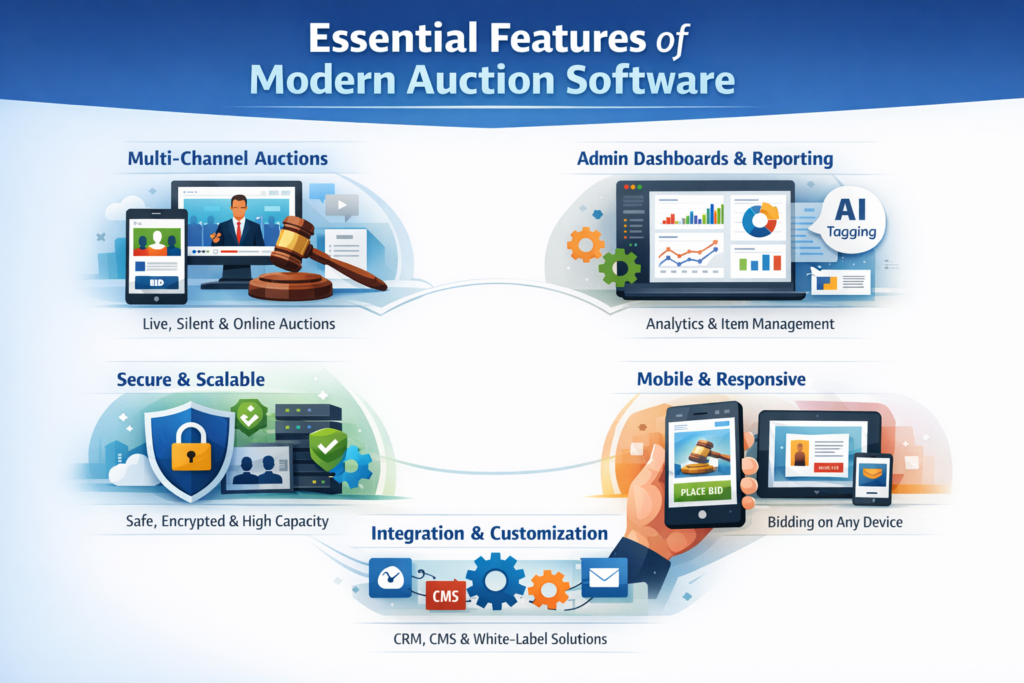
Modern clerking auction software must include:
Multi-Channel Auction Support
A multimodal auction system that combines live auctions, silent auctions, and virtual auction platforms is highly desirable. Indeed, a solid auction platform doesn’t merely accommodate different formats; it converges them to offer a streamlined interface, which promotes greater comfort among both bidders and auctioneers.
Admin Dashboards and Reporting
Effective auction management software should enable:
- Mass uploading of items is supported by tagging automatically generated by AI.
- Up-to-date reporting of bidding activity, largest bidders, items without bids, and revenue generation.
- Runner management accompanied by profile tracking and authentication.
- Pre-designed dashboards that can be adjusted to suit the detailed needs of insights.
Scalability and Security
An online auction system that is ready for the future has to be able to support a large number of bidders all at the same time, safe payment methods should be used, communications should be encrypted, and there should be no room for fraud.
Mobile and Responsive Experience
As mobile bidding is going up, auction software for websites should be able to deliver a user-friendly interface that is accessible from all kinds of devices. The use of React-based front-ends guarantees that the customers will have easy, real-time updates and excellent performance on their smartphones or tablets.
Integration and Customization
An excellent auction platform software is capable of integrating with CRM, marketing automation, and content management systems. Auctioneers are given the freedom to use customizable dashboards, branding, and white-label solutions to retain authority over their platform..
Partnering with an Auction Software Development Company
It takes a clever combination of skills like technical know-how, strategic planning, and good execution to come up with a successful online auction platform. In short, immoderate money will be spent on hiring an experienced auction software development company to get the following jobs done:
- Drives full-stack solution development with the use of React, Python, and AI integration.
- Grows the existing online auction platforms into scalable ones to support live, silent, and virtual auctions.
- With focus on the most essential basics like security, performance, and user experience.
Cyblance, a top-notch online auction platform development company, is the go-to place for the creation of custom auction websites and clerking auction software. The technical integration of the front-end, backend, and AI done by Cyblance assures the delivery of the most practical and lively solutions to their clients.
Steps to Build Your Auction Platform
1. Define Auction Requirements
Define what kind of auctions you want to hold: live, silent, or virtual, and feature set-wise, think about what features matter the most for you, like real-time bidding, AI analytics, and bidder notifications.
2. Choose a Technology Stack
- Front-end created with HTML/CSS and React to make the application user-friendly and adaptive to different screen sizes.
• The back-end consisting of Python for ensuring safe and scalable services..
• Either a relational or NoSQL database, depending on the size of the business. - AI modules for predictive analytics, catalog management, and fraud detection.
3. Partner with a Development Team
Hire an expert company in auction software development and online auction platform development, like Cyblance, to be your technological partner for rock-solid solutions and easy scalability.
4. Develop an MVP
Start with essential functionalities: item cataloging, bidder registration, bid tracking, invoicing, and dashboards. Concentrate on mobile responsiveness and security.
5. Testing
Conducting load tests, security audits, and user acceptance tests. Gradually add AI features to improve the use of the software.
6. Launch
Launch your auction platform software with the help of marketing pipelines, email notifications, and bidder engagement strategies.
Benefits of Modern Auction Clerking Software
- Reaching the audience worldwide: Access to bidders from all over the world by using an online auction platform.
- Enhanced Efficiency and Accuracy: Use software to handle cataloging, bidding, invoicing, and reporting.
- Data-Driven Decisions: Monitor the behavior of the bidders to conduct better auctions in the future.
- Brand Control: Custom auction platform software gives the possibility of a white-label product and total branding.
- Scalability: Contemporary tech stacks guarantee that your system adapts to your company’s expansion.
Challenges to Consider
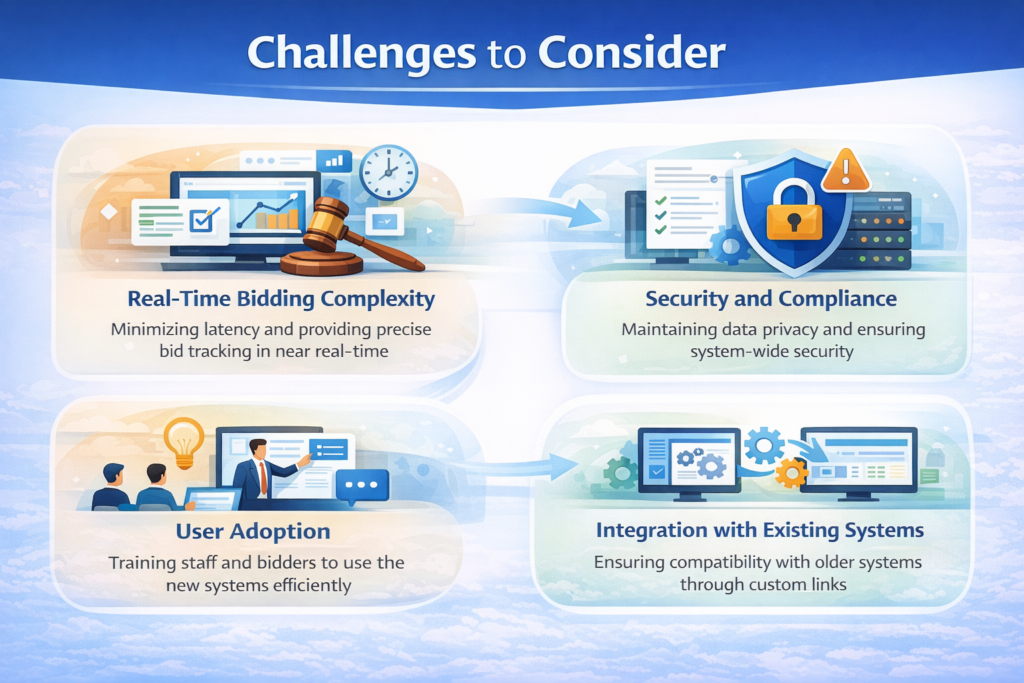
- Real-Time Bidding Complexity: Minimizing latency and providing precise bid tracking as close to real-time as possible.
- Security and Compliance: Maintaining the privacy of the bidders’ data in addition to keeping the security of the system as a whole in order to prevent fraud.
- User Adoption: Teaching and training staff members and bidders on how to efficiently work with the new systems.
- Integration with Existing Systems: Older systems are likely in need of tailor-made links to be compatible with the new system.
Conclusion
The future of auction clerking software is centered on technology, innovative, and versatile to a great extent. In any case, as a result of technology coming to his help, a modern auctioneer can seamlessly utilize any software that combines React, Python, and AI to get the maximum out of live, silent, or virtual auctions. Teaming up with a proficient online auction platform development company like Cyblance guarantees a system that is scalable, safe, and has rich features. The range moves from simply starting an auction website to creating imaginative bidder journeys that are unlimited in number and allow the company to experience its efficiency, expansion, and global outreach.
FAQs for Auction Clerking Software
A specific auction management software aiding clerks in a bid journey, managing objects, printing invoices, and providing snapshot information.
Yes, a contemporary auction platform software facilitates hybrid auctions, which involve the smooth tracking of bids both for a live and virtual event.
React delivers a dynamic, user-friendly UI; Python offers robust backend operations and adds the possibility of AI integration.
AI facilitates predictive bidding, automated cataloging, fraud detection, and personalized bidder notifications.
Full-stack development that is comprehensive, including AI, auction system design, security, and scalability after the launch. For example, Cyblance.