



TL;DR — If you need speed along with a low upfront cost, go for SaaS. If you want different workflows, deeply integrated systems, or data ownership, and can afford to make an upfront investment, then choose a custom-built website (or headless + managed hosting).
Building or subscribing? That is the big question that every company faces when it decides to launch or upgrade its website. The debate between website build cost and SaaS recurring fees is not only about money; it is also a matter of flexibility, ownership, scalability, and long-term sustainability.
We conducted a comprehensive website cost analysis (in USD) to identify the primary factors contributing to the cost of building a website, as well as the typical recurring costs associated with maintaining a website. In addition, we will also describe how to figure out your total cost of ownership (TCO), which is a prerequisite for deciding on custom development or a SaaS solution.
What Determines Your One-Time Website Build Cost?
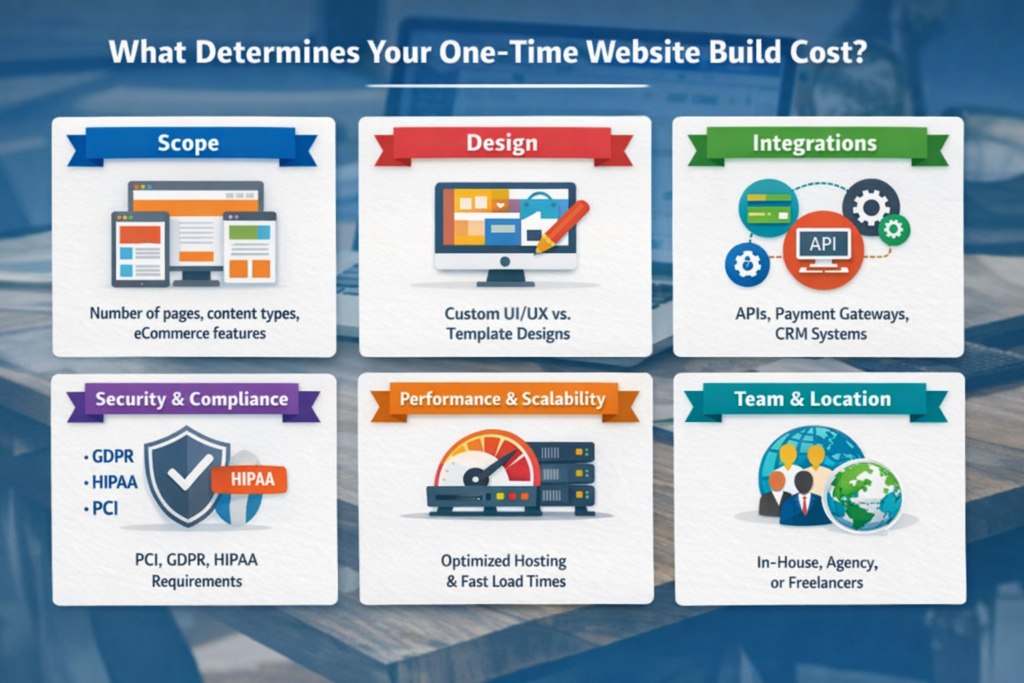
Website development costs are mainly influenced by various technical and business parameters. Here is a list of the major cost drivers along with an explanation of what they mean in practice:
- Scope – The number of pages, content types, user roles, CMS setup, eCommerce components, and unique workflows all influence the build price. For instance, a 5-page static site is absolutely different from a dynamic marketplace or auction platform.
- Design – Employing ready-made templates is a very wallet-friendly option, on the contrary, a custom UI/UX made specifically for your brand identity will raise the price considerably but will bring a higher engagement level.
- Integrations – Payment gateways, shipping APIs, CRM systems, tax tools, and analytics are technical layers that require developer hours. Every API adds to the time, and also to the testing that needs to be done.
- Security & Compliance – if your business involves the making of payments or the handling of user data, you might need to be compliant with PCI, GDPR, or HIPAA. There are developers and legal professionals’ fees involved in the implementation and the maintenance of these compliances.
- Performance & Scalability – Your site will be fast and stable through the use of optimized hosting, caching, and CDN. Nevertheless, they need to be configured by an expert.
- Team & Location – Choice of an internal team, collaborating with a top-notch custom web development agency such as Cyblance, or employing global freelancers from platforms like Upwork; all these choices can drastically alter the hourly rate and the total project cost.
“A carefully designed scope and tech stack can spare you thousands in rework and recurring SaaS expenses down the line.” – Cyblance Insights.
Typical Website Development Cost Bands (USD)
Here’s a realistic breakdown of website build cost ranges, with one-time and ongoing charges.
| Option | Typical One-Time Build (USD) | Monthly Recurring (USD) | Notes |
|---|---|---|---|
| DIY SaaS Builder (Wix, Squarespace, Hostinger) | $0–$2,000 | $5–$50 (base) + apps |
Provides quick launch but has limited customization.
(Source: Website Builder Expert) |
| Small Custom Site (Freelancer/Agency) | $3,000–$20,000 | $20–$200 |
Ideal for SMBs wanting branded design & moderate complexity.
(Source: SpdLoad) |
| Medium Complexity / eCommerce | $20,000–$100,000 | $200–$2,000 |
Custom design, advanced checkout, inventory systems.
(Source: Adobe Commerce) |
| Enterprise / Marketplace / Auction | $100,000+ | $2,000–$20,000+ |
SLAs, dedicated infrastructure, enterprise-grade security.
(Source: FullStack Labs) |
Note: These numbers are averages. Real-world quotes vary based on region, features, and vendor experience.
SaaS Website Recurring Cost Drivers
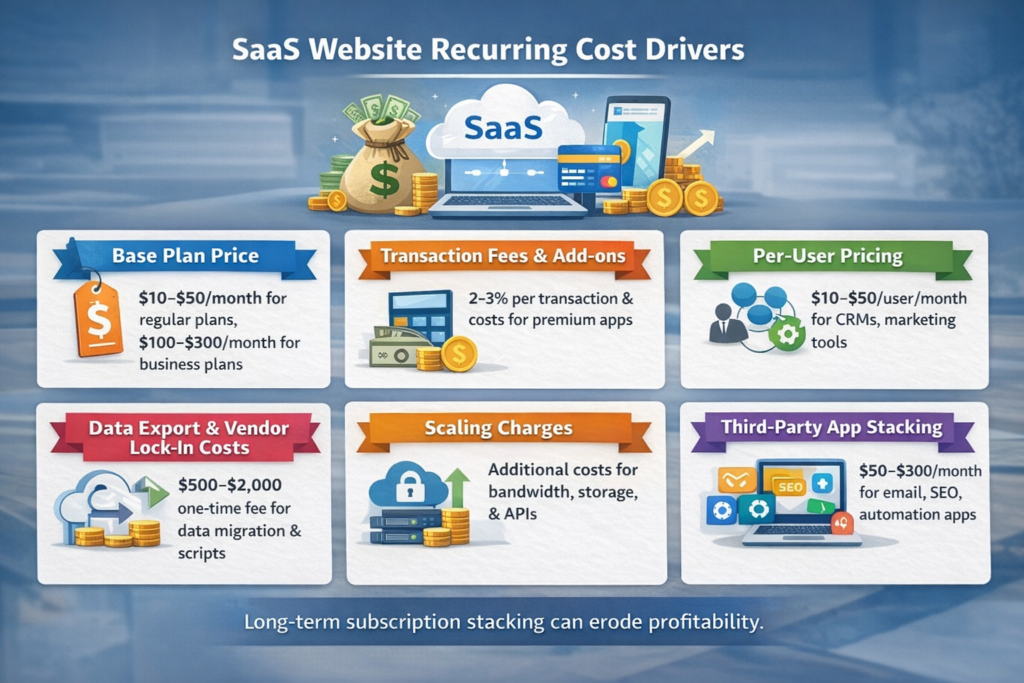
Initially, SaaS (Software-as-a-Service) platforms may appear to be less expensive than they are, but the recurring costs add up most of the time. Here’s what you should track:
- Base Plan Price – Usually, a regular plan for a SaaS website builder is in the price range of $10 to $50 per month. Nevertheless, a high-end business or e-commerce plan can cost from $100 up to $300 per month.
- Transaction Fees & Add-ons – Platforms like Shopify or BigCommerce usually charge 2–3% per transaction. In addition to that, these platforms impose some extra charges if there is a utilization of third-party payment processors or if there is a use of a premium checkout app.
- Per-User Pricing CRMs, analytics, or marketing automation tools may charge $10–$50 per active team member per month, depending on the feature tier.
- Data Export or Vendor Lock-In Costs – A one-time fee in the range of $500–$2,000 for data transfer, custom scripts, or downtime may be charged when migrating from SaaS.
- Scaling Charges – The increased traffic on your site may also result in additional charges for bandwidth, storage, and API, which can range between $20 and $200 per month, depending on your hosting tier and content volume.
- Third-Party App Stacking – Email marketing, SEO, analytics, or workflow automation plugins that you might unaware of can add $50–$300 per month to your overall subscription stack.
SaaS websites are great for speed and convenience. However, long-term subscription stacking can quietly erode profitability.
Total Cost of Ownership (TCO): 1-Year, 3-Year & 5-Year Math
| Scenario | 1 Year | 3 Years | 5 Years |
|---|---|---|---|
| DIY SaaS (Wix/Squarespace) | $900 ($600 for setup + $25/month) | $2,700 | $4,500 |
| Mid SaaS (Shopify with Apps) | $3,360 ($2,000 for setup + $100/month + $30 apps) | $10,080 | $16,800 |
| Custom Made + Hosting | $11,200 ($10,000 for development + $100/month) | $13,600 | $16,000 |
SaaS subscriptions offers less control and flexibility as compared to custom built websites while costing as much as a custom website over a period of three to five years.
Which Software Fits Your Business? (recommendations)
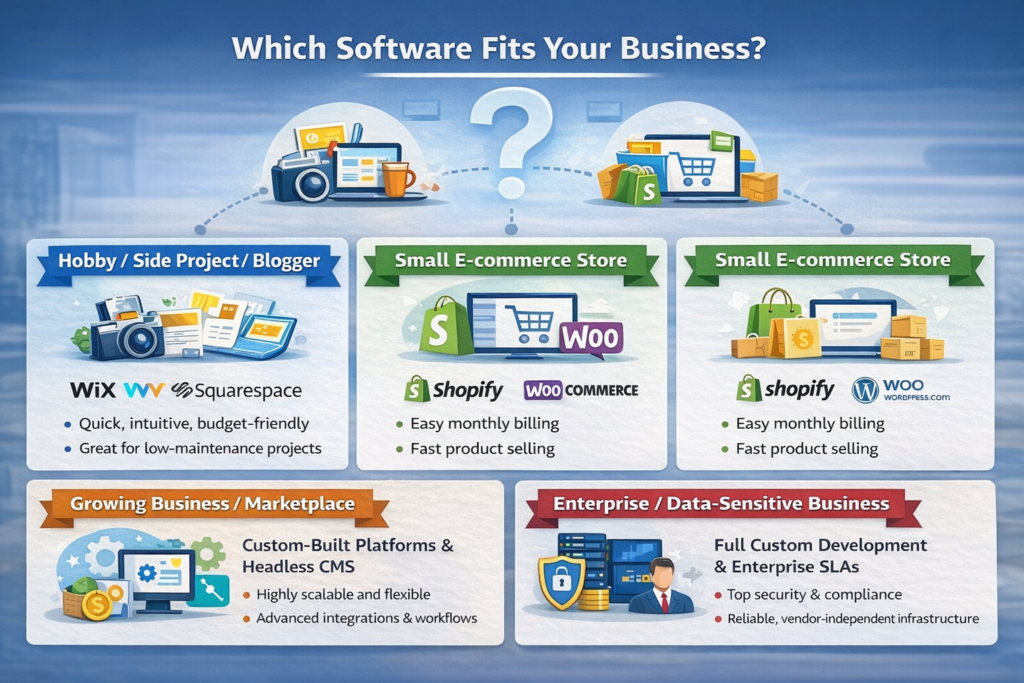
Different business goals require different technology solutions. Here are the most suitable ones for each case:
- Hobby / Side Project / Blogger – Select SaaS website builders like Wix, Squarespace, or WordPress.com. They are quick, intuitive, and budget friendly. They can be perfect choice for such low-maintenance projects. (Source: Tom’s Guide, 2025)
- Small e-commerce Store – Choose Shopify or WooCommerce (on managed WordPress hosting) for such applications. You will be billed monthly, but your products will be sold quickly. (Source: Website Builder Expert, 2025)
- Growing Business / Marketplace – Custom-built platforms or headless CMS solutions that provide the flexibility for integrations, workflows, and scaling without platform limits are an ideal choice for growing businesses. (Source: SpdLoad, 2025)For scaling businesses or niche marketplaces, custom-built platforms or headless CMS solutions offer the flexibility to integrate advanced workflows, APIs, and business logic without platform-imposed limits.Compared to SaaS-based builders (like Wix or Shopify), custom and headless architectures provide greater scalability, control over data, and deeper integration with CRM, ERP, and analytics systems. While their initial development cost and setup time may be higher, their long-term Total Cost of Ownership (TCO) is often lower because businesses avoid recurring licensing fees and vendor lock-ins.
- Enterprise / Data-Sensitive Business – Choose full custom development, enterprise SLAs, and dedicated infrastructure for a data-sensitive business. Prioritize compliance, reliability, and vendor independence. (Source: FullStack Labs, 2025)
“At Cyblance, we help clients choose the tech stack that minimizes total cost of ownership while maximizing scalability.”
Pros & Cons Matrix
Here’s a quick comparison between SaaS websites and custom-built solutions in terms of speed, cost, flexibility, and control:
| Factor | SaaS Website | Custom Made Website |
|---|---|---|
| Speed | Instant deployment | Development time is large |
| Flexibility | Limited customization | Fully flexible |
| Upfront Cost | Low | High |
| Ongoing Cost | Continuous subscription charges | Predictable maintenance charges |
| Vendor Lock-in | High | None |
| Data Ownership | Limited control | Full control |
| Security/Compliance | Managed by vendor | You define the policy |
(Source: Website Builder Expert, 2025 & SpdLoad, 2025)
Hidden Costs to Consider
There are always hidden costs in the lifecycle of a website that later tend to show up, even if the price looks very clear and simple at first.Knowing them will let you plan your budget better and be sure that you will not have any surprise problems:
- Licensing Fees – Most advanced plugins, integrations, and API services usually require a premium license that is renewed either yearly or monthly, thus, they add recurring costs to your operational expenses.
- SSL & Domain Renewals – The SSL certificates and renewal of domains charges are generally somewhere between $10 and $200 per year. These charges will depends on the registrar and the level of protection required. (Source: TechRadar, 2025)
- Backups & Data Retention – Separate monthly charges might be charged for automated cloud backups or long data retention plans. it ranges from $10 to $50, especially for websites with high traffic or large amounts of data. (Source: Pulseway, 2025)
- Developer Hours – Routine feature updates, bug fixes, and performance optimizations are, in general, additional developer work; hence, they may become ongoing maintenance costs, particularly for custom-built or dynamic websites.
- Data Migration – When moving from one CMS or SaaS platform to another, companies can have a bill for data export, content reformatting, and downtime, which can easily go as high as hundreds or even thousands of dollars.
By anticipating these factors early, businesses can prevent budget overruns and ensure a smoother long-term digital strategy.
Quick Decision Framework: Ask These 6 Questions
Before deciding on a SaaS platform or a custom-built website, reflect on these six questions. They will assist you in making a trade-off between cost, control, and scalability.
- How fast do I need to launch?
Quick launching is possible with SaaS platforms that can be live in no time. Custom builds will take more time. - Do I need custom workflows or integrations?
In case unique processes and third-party systems are required, then it is better for you to have a custom website that allows deeper integration. - What’s my tolerance for recurring vs. upfront spend?
SaaS keeps the costs per month; custom builds require a higher upfront investment but fewer fees in the long run. - How sensitive is my data (PCI, GDPR, or other regulations)?
When data security and compliance are of utmost importance, it is safer to have a custom build where you have full ownership. - Do I want full ownership of my code and data?
With a SaaS solution, you get limited access and portability. On the other hand, with custom development, you have full control. - What’s my expected traffic and transaction volume?
There is a possibility that SaaS will scale the costs with the traffic; however, custom architecture provides stable, predictable scalability.
Answering the questions helps you figure out whether SaaS convenience or custom scalability is a better fit for your long-term business goals.
Sample Cost Case Studies
Example A — Startup Marketplace
Consider a case where a startup that is progressively expanding requires to create a custom auction marketplace that can be scaled in the future.
- Custom MVP Build: $60,000 one-time + $2,000/month maintenance = $132,000 over 3 years (TCO)
- SaaS Marketplace Alternative: $500/month subscription = $18,000 over 3 years (TCO)
Insight: At first glance, SaaS seems to be much cheaper than custom development. However, the latter provides more flexibility, branding control, and freedom from platform constraints. Therefore, the upfront investment pays off when the business scales and requires advanced features.
Example B — Local Boutique Store
A boutique retailer is evaluating whether to launch on Shopify or build a custom WooCommerce store.
- Shopify Basic Plan: $39/month + apps ($70/month) = $1,308 per year → $3,924 over 3 years (TCO)
- Custom WordPress eCommerce: $6,000 build + $50/month hosting = $7,800 over 3 years (TCO)
Insight: Small retailers can effectively start their businesses with SaaS solutions such as Shopify, which are quick and cheap. However, a custom WordPress will provide a better return of investment over time when there is a need for stacking apps and gaining customization.
An increasingly startup is looking to develop a custom auction marketplace that can be scaled later.
According to Total Cost of Ownership (TCO), custom-built solutions dominate in long-term value, scalability, and full ownership, while SaaS platforms win in the short term for agility and lower entry barriers.
Hidden Insights from Industry Experts
“Even though SaaS looks cheaper, businesses often pay 30–50% more in the long run due to add-ons, integrations, and data migration.” — Excerpt from Cyblance
FAQs
Yes. For small businesses, but over 3–5 years, recurring charges often match or exceed custom development.
In 2025, building an eCommerce website in the U.S. typically costs $500–$20,000, depending on complexity and platform choice.
- Basic SaaS platforms (like Shopify, Wix, or Squarespace) typically cost $500–$5,000, including setup and annual subscription fees.
- Moderate solutions (like WooCommerce with plugins and hosting) may range between $5,000–$20,000.
- For custom or enterprise-grade platforms, especially those with multi-vendor capabilities and custom backends, costs can extend up to $100,000 or more — but this applies only to large-scale, tailor-made systems.
(Source:Website Builder Expert, 2025;WebFX, 2025)
The most likely amount will be anywhere from $20 to $200 per month. The money will be used for hosting, backups, and security updates.
Yes, but expect additional migration, data cleaning, and downtime costs.
Nearly 10–20% of the initial development cost per year will be kept aside for the updates, bug fixes, and security patches.