



Over time, the way consumers shop online has undergone significant changes. In the current market, classic e-commerce platforms continue to lead. Yet many buyers are asking for more: such as being entertained, taking part in a contest, and getting nice bargains. These are the reasons why auction-based e-commerce platforms are gaining popularity. One can say that for businesses, auctions mean more interaction, higher prices through competition, and a more engaging buying process.
If you had thought about creating a custom auction-based eCommerce platform, you would actually be on the way to success. Website quality not only enables the sale of products but also builds a comprehensive system where buyers engage, sellers thrive, and your brand attracts attention among numerous online competitors. Why so? The answer is a combination of auctions, must-have features, and technologies like Python, Shopify, WordPress, HTML/CSS, React, and even AI that make your launch a success.
Why Build an Auction Website in Today’s Market?
Online auctions inject a thrill factor that is absent in traditional eCommerce stores. Buyers do not just “browse and buy”; instead, they become interested in a challenge to compete and win. Thus, they keep coming back to you, and your platform becomes more addictive.
Auctions are highly flexible from a business perspective. You can auction off rare collectibles, sell the surplus stock, or offer services. Due to the competitive spirit, most products are sold for more than their original price. What is even more important is that you receive a strong auction-based platform that fosters trust, provides you with more exposure, and sets you apart from other brands.
The Benefits of an Auction-Based eCommerce Platform
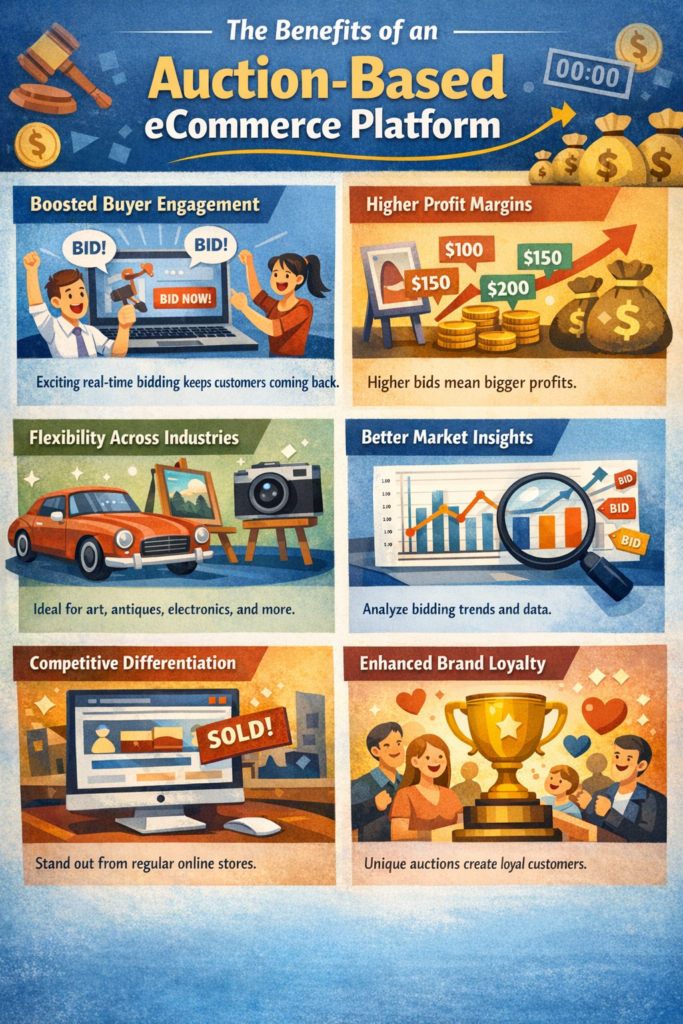
Boosted Buyer Engagement
Customers who have the opportunity to bid in real time will feel more invested. The excitement of getting involved in a contest is to them like a drug – they are more likely to return to your website, spend more time there, and also share it with their friends.
Higher Profit Margins
Through auctions, the market sets the value. Suppose more than one person is interested in buying a product. In that case, the final price at which the product is put on sale is likely to surpass your expectations, ultimately resulting in larger margins.
Flexibility Across Industries
An auction e-commerce platform that operates on a bidding system is suitable for sales in different categories, e.g., art, antiques, electronics, and vehicles. The reason for such diversity is that it is equally perfect for small and large businesses.
Better Market Insights
The examination of bidding patterns closely and regularly can provide a treasure trove of information Bids. For instance, you can determine the products that attract the highest number of bids, the categories that are vibrant during a particular period and what the best results would be by using the correct starting prices..
Competitive Differentiation
A custom auction website is what makes you different from traditional online stores. Providing a buyer with a one-of-a-kind experience not only fosters loyalty but also positions your brand as a market leader in your industry.
Must-Have Features of a Custom Auction Platform
To retain users and maintain a regular transaction flow, your auction website should have strong, easy-to-use features that are accessible to all users.
User-Friendly Interface
A user-friendly design enables visitors to register, bid, and complete their purchase with ease. The main thing is keeping it simple so you can maintain your customers.
Real-Time Bidding System
The core of any real-time auction is live updates. Quick alerts enable bidders to react faster, making the auction more competitive.
Secure Payment Integration
Buyers feel secure. Several payment plans, including credit card, PayPal, and digital wallets, provide the buyer with a service of trust and ease of use.
Auction Timer & Alerts
Countdown timers evoke the feeling of a last chance, and email or SMS alerts received by users until the very last moment keep them engaged.
Personalized Dashboards
Both buyers and sellers require transparency. Dashboards show bid histories, transactions, and upcoming auctions.
Mobile Responsiveness
Almost all users who use smartphones to surf the web consider mobile-first design a must-have, rather than a matter of choice.
Reviews and Ratings
Trust plays a vital role in any auction. The introduction of a review system facilitates the formation of a marketplace.
Choosing the Right Technology Stack
The technology that was specifically chosen is indicative of the way the platform you have will be functional, safe, and scalable.
Python for Powerful Backends
Python frameworks such as Django provide reliability and also allow for scalability. Besides all these, they can even perform the platform’s primary operations, such as bidding logic, payment management, or user flows, without any hiccups.
Shopify for Fast Deployment
For companies willing to experiment with the auction model quickly, Shopify will provide ready-to-use plug-ins with customizable options, allowing them to easily integrate their auction systems without the need for burdensome coding.
WordPress with WooCommerce
By utilizing the open-source extensions of WooCommerce, setting up a business model based on auctions will become a seamless process, particularly for small to medium-sized businesses seeking affordable solutions.
HTML/CSS for Modern Styling
Solid frontend styling ensures that your website will be visually appealing and provide a professional user experience.
React for Dynamic Interfaces
With the help of the real-time bid update feature in React, all these live interactions can be implemented in a way that keeps the platform user-friendly and engaging for users.
AI for Next-Level Performance
AI will be able to anticipate the bidding habits of customers, flag any suspicious activities, and also create personalized suggestions, thus making your auction platform a more innovative tool for business.
Steps to Building a Custom Auction-Based eCommerce Platform
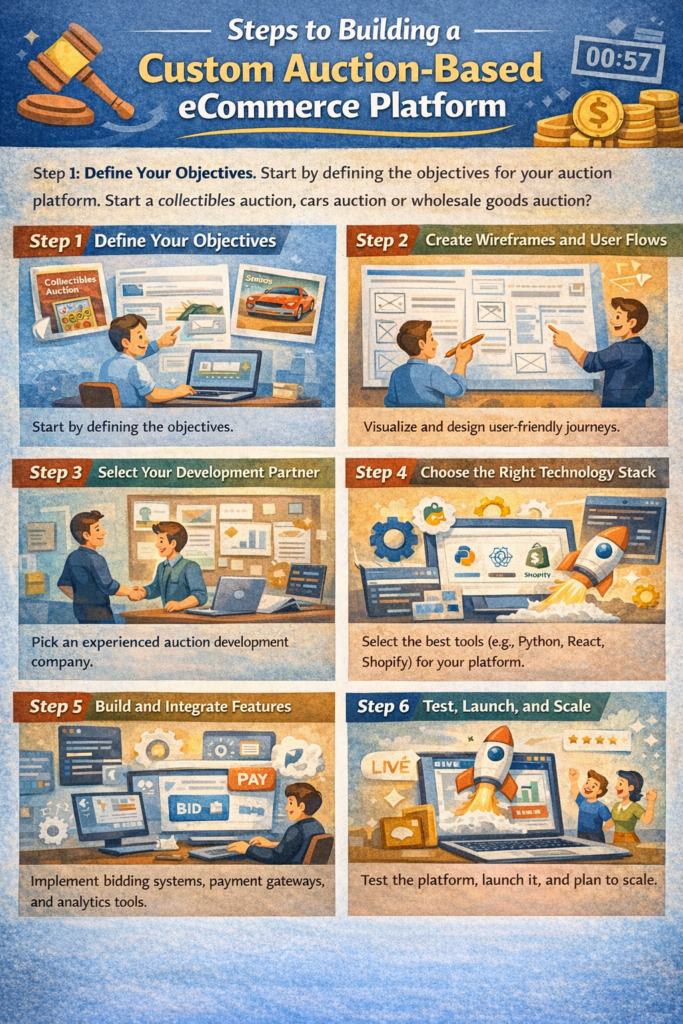
Step 1: Define Your Objectives
Start by defining the objectives. Decide whether you want to start a collectibles auction, cars auction or wholesale goods auction? Every choice will require specific features.
Step 2: Create Wireframes and User Flows
Visualize the journeys that buyers and sellers follow. Your design should be built based on the principles of user-friendliness and transparency.
Step 3: Select Your Development Partner
Just after that, you work with a professional and experienced custom auction website development company, and you turn it into a platform that meets world standards and beyond.
Step 4: Choose the Right Technology Stack
Connect your goals with appropriate tools such as Python, React, and Shopify. This is how you can ensure that your platform meets your performance targets.
Step 5: Build and Integrate Features
Allow the users the necessary features—bidding systems, payment gateways, user-friendly interfaces, and analytics tools—to facilitate user interaction to the greatest extent possible.
Step 6: Test, Launch, and Scale
To release the product, thorough testing must be conducted. Apart from the release, you also have the opportunity for ongoing development and scaling.
Why do you require a Custom Auction Website Development Company?
An auction website differs from a general e-commerce store. The site should have real-time bidding systems, security, and scalability. An experienced online auction platform development companyknows such intricacies and creates long-lasting solutions.
An alliance that you can rely on, such as Cyblance, is capable of taking your platform to the next level, not only technically but also from the point of view of user-friendliness. Cyblance, where you can have everything from microservices to AI integration, customizes solutions to help you grow.
How Cyblance Adds Value
At Cyblance, we have been the source of transformation for multiple companies designing and launching auction-based platforms that genuinely matter. Our expertise spans the entire process – from efficient backend setup in Python to the creation of an appealing frontend with React.
We made this statement in one of our latest blog posts: “Online auctions enable businesses to reinvent eCommerce after engaging rather than merely selling.” This conviction we hold turns every project we do into a client’s success by keeping the kick-off of platforms that are extendable, groundbreaking, and lucrative.
The Role of Microservices in Auction Development
Modern auction systems use a microservices architecture to gain advantages. The platform is divided into multiple independent services, including bidding, payments, and notifications, rather than a single monolithic application.
Thus, if a service encounters trouble, the other services will still be able to operate without disruption. It is also possible to seamlessly integrate new features alongside existing ones using microservices, thereby ensuring the rapid growth of your business.
Real-World Use Cases for Auction Platforms

- Art and Collectibles: The selling of art and rare collectibles at auctions attracts competitive bidding and buyers from all over the world.
- Automobiles: Buying and selling of automobiles through auctions can be made more efficient, specifically for used vehicles.
- Real Estate: A large volume of audience can access high-value properties via online auctions. This makes the entire process more transparent and efficient.
- Charities and Fundraisers: Auctions not only raise funds but also involve the community, which is a great way to engage them in meaningful ways.
Future Trends in Auction-Based eCommerce
AI will create more efficient bidding systems that can foresee user behavior and offer them suitable strategies. The use of blockchain can make auctions more transparent as the records of the bids can be made tamper-proof. The use of mobile-first designs will remain very popular, and the integration of payments from different parts of the world will make it easier for bidders from various countries to participate in the auction.
FAQs
Auction websites typically attract more user interactions, enable higher prices to be achieved, and offer customers experiences that are entirely new and unmatched by even the best eCommerce stores.
Python, React, Shopify, and WordPress are perfect tools to make your decision easier. These four varied and flexible business comprehensive solutions have different goals and budget requirements.
If all the development steps are strictly followed, payment gateways are adequately secured, and fraud detection measures are firmly in place, then auction platforms can be very secure.
Of course. Through microservices architecture and cloud hosting, the number of users, bids, and transactions can increase on your platform without compromising its performance.
Cyblance is a very well known e-commerce store development company. The technical experts at Cyblance build custom auction platforms that are secure, scalable, and future-ready.